
Showing posts with label Aspen Gold Award finalist. Show all posts

Monday, September 5, 2016

Labor Day News & Update on Pets in Space

Can you believe it's Labor Day already? I can't. Oh where oh where did the summer go?

I have an announcement and a patio garden report, and then another fun Pets in Space Anthology update. That October 11th launch date seems to be coming up at FTL speed!

So first of all, I have some great news concerning my novel Inherit the Stars (which, by the way, is a companion to my Pets anthology story). And here it is...


That's right! Inherit the Stars is once again a finalist with a shot at another award, after winning the 2016 Carolyn Readers Choice Award earlier this spring. Co-blogger Pippa Jay won the Aspen Gold in a previous year, so I'm hoping I can join her in the ranks of Aspen Gold winners. :D

Labor Day seemed like a very good time to do an update on my patio garden. You might remember this earlier photo blog from July: Meanwhile Back at the Ranch

This is the first year I had any time to devote to a hobby garden, and I'm pretty happy with how well things went over the summer. Let me share a few photos that were just taken this weekend.

First...woohooo! My trophy! Yes, I picked a pepper! :D

I was so proud of this little cutie. It's a miniature orange bell pepper, the first product ever harvested from my patio garden. And yes, it was delicious! Yum!

First pepper! Miniature orange bell pepper--patio grown.


A large pot of seed-grown marigolds.


My patio garden is now nearly a patio jungle!
It's mainly marigolds, petunias, dianthus,
tomatoes and peppers.

Patio garden view #2. Note the rainwater
collection tank in the middle top.
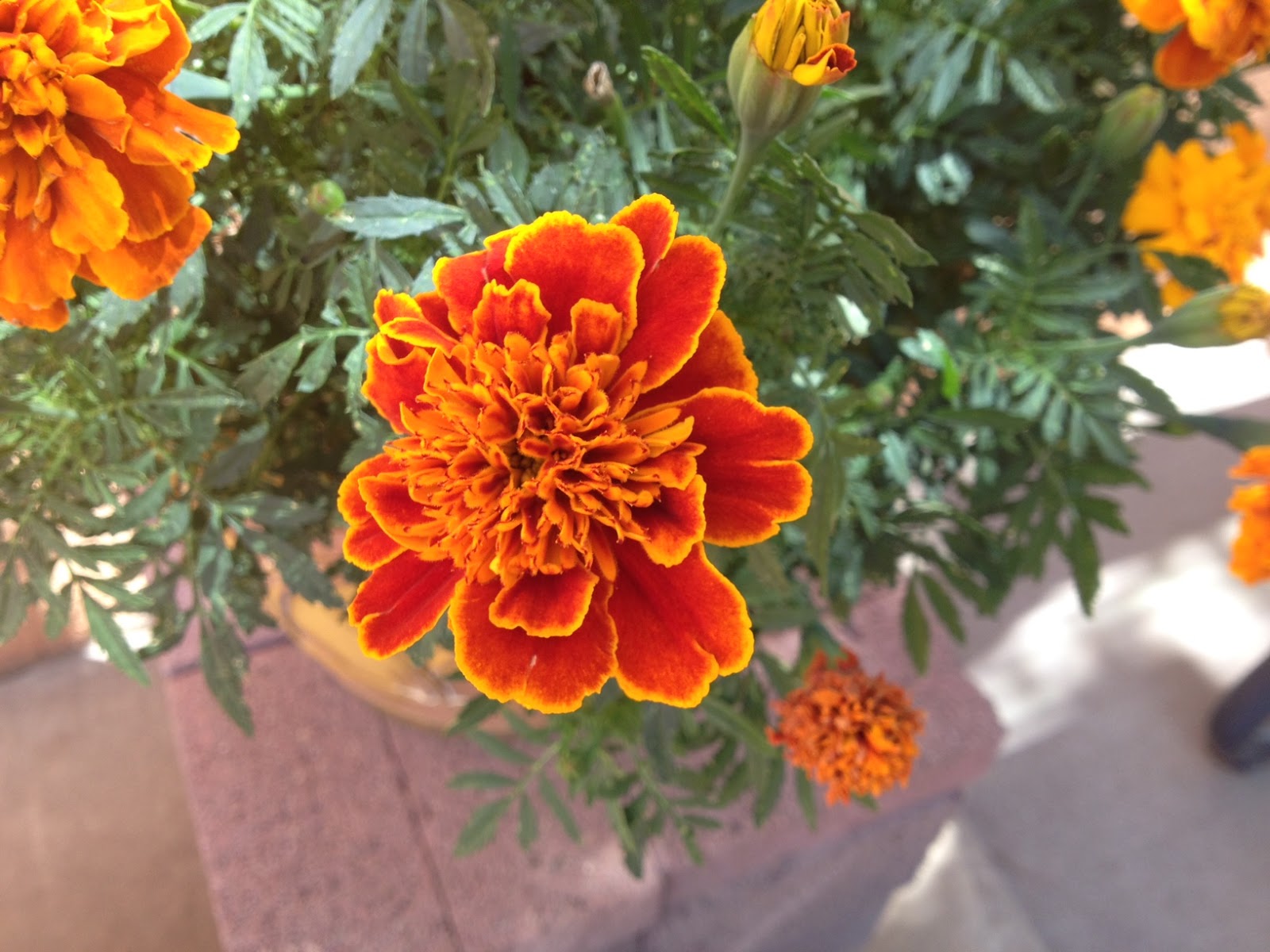
Close-up of a variegated marigold.

More marigolds. I like to grow these because
they naturally repel pests and seem to do well
in our hot and dry New Mexico environment.


Wall garden. Marigolds, lavender, petunias and dracaena.

Pottery row. In the background, you can see
that we actually have some pretty lush
green grass this year, thanks to heavy
monsoons that started in late July.
 
Some of you might want to close your eyes for this next one if you have arachnophobia!
 
Our patio garden also includes a few friendly spiders. Although this guy looks pretty nightmarish, he's really quite harmless and eats a lot of insects that like to eat our plants.
 
We think these spiders are a variety of Orb spider. They start appearing everywhere in late August and stick around until first frost. This guy was hanging around outside my front door. (He'll be relocated to a juniper tree a few feet away. I really don't want to walk into him or his web!)
 

All in all, I think my Project Patio Garden 2016 was a great success and had the added benefits (besides the fresh peppers and tomatoes) of being a relaxing way to enjoy a little fresh air away from my computer this summer.

PETS IN SPACE ANTHOLOGY UPDATE

Since it's labor day, I thought it might be fun to reveal a few of the professions of the characters in the upcoming Pets in Space Anthology novellas and novelettes.

After all, it isn't just about the pets. Well, a big part of it is, of course, but it's also about the people who love them. Sometimes the characters' jobs are compatible with their pets, sometimes they're not, and sometimes they serve as a catalyst to send them off on a crazy adventure.

You can imagine all the fun and excitement this anthology promises--all while pulling on your heartstrings. Because what could be more fun than science fiction plus romance plus pets!  :D

Here's a brief introduction to four of the human characters from the anthology, and there might be just a hint or two about some of the pets they love, adopt or partner with.

Emma Standish of The Real Dragon
Emma Standish is her father’s research assistant. This is not the job she wanted, but she stayed to help her father, a for-real rocket scientist, when her mother passed away. But nothing is quite what it seems in “The Real Dragon.”

Pauline Baird Jones never liked reality, so she writes books. She likes to wander among the genres, rampaging like Godzilla, because she does love peril mixed in her romance. You can find out more about her books (and get a free story for subscribing to her newsletter) at: paulinebjones.com

Owen Embersson of Star Cruise Stowaway
Owen Embersson is ex-military and is now employed as the Cargo Master aboard the interstellar cruise ship Nebula Zephyr, which carries 2000+ passengers and two full decks worth of freight on every cruise. He’s responsible for getting cargo on and off the ship, and keeping it safe during the voyages. He supervises a small crew of logistics experts, and has a soft spot for his rescue cat Moby.
 
Amazon best-seller Veronica Scott is a three-time recipient of the SFR Galaxy Award, and has written a number of science-fiction and fantasy romances. She is the SciFi Encounters columnist for the USA Today Happily Ever After blog, and recently voiced a ‘red shirt’ crew member in an official Star Trek audiobook.
 
Dante Stone of Spark of Attraction
Cyborg Dante Stone is in the military and is the captain of the Crimson Hawk, a warship (spaceship), which rescues archivist Miranda Lowell after an alien attack.
 
USA Today best selling author Cara Bristol is the author of more than 27 books, including the Cy-Ops Sci-fi cyborg romance series. 

Taro Shall of StarDog
Taro Shall is a professional star navigator who's served aboard a number of ships, but none like the specialized transport carrier Calypso. It's totally his dream job. The vessel has unique, high tech capabilities that has him charting a course to some pretty amazing places. Unfortunately, there is a downside (but he's sworn to secrecy about that). Still, even high tech ships can develop low tech troubles, and that's how a StarDog--and Adini Kemm--come to cross his flight path.

Laurie A. Green is an award-winning author of science fiction romance and founder of the SFR Brigade, which now has nearly 900 members. She is a retired military budget director and formerly served as a reserve law enforcement trooper for her state.


Hope you all had a great summer, too.
 
Have a great week!
 
Laurie

Monday, August 29, 2016

Biggest Discovery of the Century: What Does it Mean?

Some HUGE news that broke last week. Scientists have discovered what may be an Earth-like planet in the habitable zone orbiting the nearest star, Proxima Centauri, a small red dwarf sun about 4.25 light years away.

Promptly named Proxima b, the planet is only about 1.3 times the size of Earth and appears to have conditions that may allow it to have liquid water. That's exciting! So now it seems not only are there potential New Earths out there, but one may be practically on our doorstep.

We've gone from "are there even other planets beyond our solar system?" to "we've found a planet or two!" to "we've found thousands" to "we've found an Earth-like planet orbiting the nearest star!" in a very short time on the scientific time scale. That totally gives me goosebumps!

But what does it really mean that we've found a potentially habitable planet that's very close to Earth?

First of all, define "very close." Proxima Centauri is only a little over four light years away, but that, as the name implies, means we'd have to travel over four years at the speed of light to reach it. We can't even begin to approximate light speed, so how long would it take to get there with our current propulsion systems?

First, a reality check. Remember it took the Voyager craft about 40 years just to reach to edge of our own solar system.  That's like taking 40 years just to reach the door of our house, and still having to travel a mile down the road to the nearest neighbor.

So, if by "current propulsion systems" we're talking about the speed of the New Horizons probe that reached Pluto, we're talking around 54,400 years to reach Proxima b. (And New Horizons was relatively quick. The space shuttle would take about 165,000 years!)

We might be able to "soup up the engines" and cut that timeline down in the next few decades with dynamic new types of drives, but even reducing the transit time by 75% is still 13,600 years. That goes so far beyond the concept of "generation ship" that it's laughable. We're talking about sending people on a journey for 540 generations!

Even reducing the trip to 13,600 is still a span of time greater than all of recorded human history on Earth. And living in the weightless environment of space, by the time the five-hundred-fortieth generation reached Proxima b the chances are the passengers may have lost the ability to even tolerate the gravity of the planet.

So what does this discovery really mean? I think it suggests two major things.

1) If we're ever going to get there, we need to start developing some form of propulsion that can get us there at least 10 times slower than the speed of light, or in about 54 years. Propulsion that can approximate half light speed, or about eleven years travel time, would be much more ideal. And, of course, if we can develop a viable way to "fold" space (ala Dune) or a hyperdrive system (ala Star Wars) or warp speed (ala Star Trek) or flashpoint (ala my upcoming Pets in Space story...teehee) that would defy "normal space" and allow us to arrive in a few hours or days, that's the ideal scenario.

2) We need to develop a reliable form of artificial gravity. The toll of weightlessness on a human who has spent less than a year in space is so dramatic, I can't envision astronauts traveling or orbitting in space for any significant amount of time and not developing major health issues. Muscle atrophy, loss of bone mass, circulation problems, eye problems, the list is long and debilitating. The gravity conditions that our species evolved in must be recreated in order for such a mission to succeed.

Though it's true initiatives like Starshot involving laser beams pushing nanoships that, if successfully developed, could reach Proxima b in about 20 years, that's not getting us into the colony business. As Larry Niven, author of Ringworld, once said, "The dinosaurs became extinct because they didn't have a space program. And if we go extinct because we don't have a space program, it'll serve us right!"

Now that we know space may be teaming with other Earth-like planets, we need to focus on the means that will realistically allow us to go there. Unless, of course, we prefer to sit back and continue our armchair space exploration until our time on this world runs out.

Read more here:
Gizmodo: New Earth-like Exoplanet Could be Discovery of the Century
Gizmodo: There May be an Earth-Like Exoplanet Less Than Five Light Years Away
Space: How we could Visit the Possibly Earth-like Planet Proxima b

 
~~~*~~~

MY NEWS

This past week, I was informed that my SFR novel, Inherit the Stars, is a finalist for the 2016 Aspen Gold Award.

I won't find out the results until later this year, but I have all my fingers and toes crossed for a second award for my novel.

Meanwhile, they sent me this way cool graphic to share.

So purdy!


~~~*~~~

PETS IN SPACE ANTHOLOGY UPDATE


It's only a little over six weeks until the debut of the Pets in Space Anthology on October 11 with pre-orders becoming available in only about four-and-a-half weeks!

Our exciting new SFR anthology is getting ready to roll out toward the launch pad!

Meanwhile, I'm starting to think about swag and I could use your input. What type of swag or prizes do you love to get? Custom mugs? Tshirts? Notepads? Bookmarks? Mousepads?

How about some of the more unusual offerings? Postage stamps? Stress reliever/hand exercisers? Hand fans?

Have any unique swag ideas to suggest?

I'm all ears. Please post in comments below. I'll share your ideas or requests with the other Pets in Space Anthology authors.

If you missed the news about the meet-and-greet with our cover model, Vikkas Bhardwaj, you can read about it in my last blog (with photo!) here. Just scroll down to the Pets in Space Anthology Update.

Take it from a sci-fi icon at the Star Wars Celebration:
Have a great week!

Laurie