Showing posts with label NASA. Show all posts

Monday, November 21, 2022

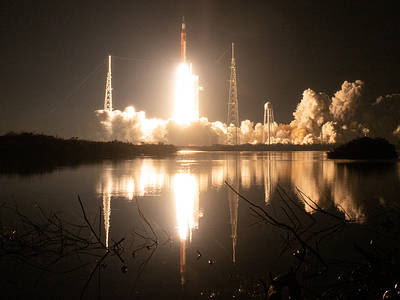
Up, Up and Away - NASA's Moon Launch

Photo credit NASA
Buried by a lot of other headlines last week was NASA's successful Orion Moon launch on November 16th.

NASA has now set a goal of sending a crewed mission back to the Moon, and continuing the work that it abandoned in 1972.

The launch was NASA's third attempt, after experiencing hydrogen fuel leaks and other technical issues on earlier scheduled launches. Hurricane Ian and Nicole also caused delays.

As the rocket hit the ignition mark and lifted gracefully off the launchpad, the NASA spokesman said:

"We rise together, back to the Moon and beyond!"

Artemis 1 is a test flight for the future Moon mission. The Orion spacecraft module will disconnect from the rocket when it reaches the appropriate point and then proceed deeper into space where it will gather information vital to future crewed missions. 

Inside the Orion's stage adapter or OSA, are 10 shoe-boxed sized CubeSats. These CubeSats will deploy from the OSA at strategic locations after the Orion spacecraft separates and has reached a safe distance. At that point, each of the "secondary payloads" will carry out different science and technology functions while in deep space.

The NASA crew was excited about the launch, posting on Twitter:

"The Space Launch System has roared to life, launching the @NASA_Orion spacecraft on its journey for Artemis I! Look out, Moon, we are on the way!"

As a Sci-Fi Romance author, I'm enthused about this big step forward and the future technologies and advances it could present. Our space program has made huge contributions to society in terms of  technology, communications, medicine, and agriculture, just to touch on a few areas. 

In addition, the Moon could provide a lot of resources to our home planet including Helium-3, a fuel that is rare on Earth but much more abundant on the lunar surface. One of the goals of future missions to the Moon could be to map these deposits for mining potential. 

If you missed the launch and you'd like to view it, you can see it here:

(To skip the prelims and go directly to launch, advance video to 5:20)


Here's a follow up mission update from yesterday that also summarizes the mission. Well worth a watch.


Reference and image source:  https://www.nasa.gov/exploration/systems/sls/launching-science-and-technology-on-nasa-s-artemis-i-mission.html


Wishing You and Yours

a Wonderful Thanksgiving 

(if you celebrate)

and many good wishes for the coming week.


Friday, July 29, 2022

FOR ALL MANKIND: A WHAT-IF FOR SPACE NERDS

What if the Soviets had reached the moon first?

Back before the heady, early days of the space program and NASA, Americans and their glacially slow government were shocked into entering the space race by the Soviet launch of their space satellite Sputnik in 1958. Three years later, in 1961, President John Kennedy vowed to send Americans to the moon by the end of the decade. NASA accomplished that goal in an incredible nine years, landing Neil Armstrong and Buzz Aldrin on the moon’s surface on July 20, 1969.

Believe it or not, the “space race” between the U.S. and the USSR pretty much ended there, and in the Seventies and the early Eighties era of glasnost (openness) both countries turned to other matters. The push for manned exploration of space lost momentum, especially after the Challenger shuttle tragedy.

But imagine for a moment that things had gone differently. You’re a young’un or a teenager (like I was) in the summer of 1969, glued to the television watching the first man stepping onto the surface of the moon. But it’s June, not July, and his name is Alexei Leonov, not Neil Armstrong. He sticks the red Hammer and Sickle flag of the USSR in the gray dust of our beloved satellite and claims it not for all mankind, but for the greater good of Marxism. That’s the opening scene of Apple TV Plus’s For All Mankind, a high-concept alternate history of space exploration created and written by Ronald D. Moore of Battlestar Galactica and Outlander fame, along with Matt Wolpert and Ben Nedivi. The three also serve as executive producers, with production handled by Sony Pictures Television and Tall Ship Production. Since the show requires a fair amount of production in the way of effects and set design, it needs all that backup.

The opening scene, with everyday Americans watching glumly as the Russians win the moon, was a real hook for me, because I remember that broadcast from the moon vividly. And I couldn’t figure out as I watched For All Mankind, why everyone was so unhappy until the last killer moment. Moore gives you a hint, of course, by sticking up a title card with the date (I think it was June 26) in front of the scene, which I knew was “wrong,” but the shock of the twist hit hard.

Once the Russkies land first, President Nixon and NASA and its astronauts must decide whether to go ahead with their planned launch in July. But Tricky Dick wasn’t about to let the Russians get the better of him. So the race is still on, not only to land on the moon, but to establish a permanent presence there. To mine its resources (first water ice, then lithium). And, eventually to use the moon as a launching pad to Mars. At each stage of the race, conflict escalates. Indeed, it becomes increasingly inevitable. Those agreements that were made to demilitarize space and declare it an international zone in our past are never made in this version of history. (Although at one point, the USSR and the U.S. are forced to divide the moon into distinct territories to avoid outright war.)

What is ironic about this is that Nixon’s once mere grudging support for the space program (because it was Kennedy’s baby) becomes enthusiastic as space becomes yet another theater of the Cold War. Resources flow to NASA (that in the real course of history were denied), new astronauts are recruited (including a whole new class of women), the Apollo program eventually launches up to 75 flights (the real-life Apollo program ended at 17, running from 1961 to 1972), new rockets and shuttle designs abound. The military sticks its nose in, too, sending Marines to the moon (where, no surprise, incidents arise) and arming shuttles with missiles. But, what the heck, the Republicans love it! (While Democrats aren’t so sure.) By the 80’s, new President Ronald Reagan is a huge fan, and the solar system is the limit.

But this is just the plot framework for the character development that is the heart of the show. (Season One covers the Seventies, Season Two starts in 1983 and Season Three works around the 1995 landing on Mars.) We meet the major characters we will be following as the show progresses in Episode One: Astronauts Ed Baldwin (Joel Kinnaman) and Gordo Stevens (Michael Dorman), their wives, Karen Baldwin (Shantel VanSanten) and Tracy Stevens (Sarah Jones), Chief of the Astronaut Office Deke Slayton (a real character, one of the original Mercury 7 astronauts, played here by Chris Bauer), Mission Control officers Margo Madison (Wrenn Schmidt), Larry Wilson (Nate Corddry) and Bill Strausser (Noah Harpster). In a seemingly unrelated segment, we also meet a young Mexican girl, Aleida Rosales (Coral Pena), crossing the border illegally with her family. (She later goes on to become a senior NASA engineer.) Finally, we meet the annoying Nixon Cabinet officer overseeing the space program, Thomas Paine (Dan Donohue).

Ed Baldwin is a pain who will forever regret he didn’t land Apollo 10 (which he commanded) on the moon to beat the Russians. This would have violated orders and probably gotten him and his partner killed, but he’s a former test pilot so those things don’t really figure. Gordo Stevens drinks too much and cheats on his wife, a pattern he eventually passes on to his son, Danny (played in Seasons Two and Three by Casey W. Johnson). Gordo’s first tour of duty on the moon base Jamestown is a disaster—he freaks out and causes the injury of another astronaut—but he later makes a solid comeback and eventually dies a hero. Baldwin, on the other hand, must suffer the indignities of growing older and facing the possibility of his own irrelevance in a young man’s game.

Personal tragedy also strikes the Baldwin family, a fact that plays into Karen’s search for meaning throughout the show. In Season Two, an Elon Musk-type entrepreneur, Dev Ayesa (Edi Gathegi) recruits her to snag talent for his company, something she’s quite good at. And suddenly the race for Mars is a three-way battle between private enterprise, NASA and the Russians.

In Season One we meet the first class of female astronauts in an episode titled “Nixon’s Women.” Despite pushback from NASA and the male astronaut corps, Nixon is adamant after the Russians show the smiling face of the first female cosmonaut beaming from the moon. According to this alternate history, NASA calls back several pilots from an original Mercury 13 group of women recruited and trained along with the Mercury 7 astronauts but dismissed and never allowed to go into space. (The real story is that 13 women were indeed put through the same training as the Mercury 7 astronauts by a private businessman, William Randolph Lovelace II, in the early Sixties. Despite lobbying Congress to be part of NASA’s program, they were rejected. One of the 13, Wally Funk, eventually went to space on a Blue Origin flight in 2021 at the age of 82, making her the oldest woman in space.)

Daredevil pilot Molly Cobb (Sonya Walger) was one of those originally trained, and she stays at the head of her astronaut class, with Ellen Waverly (Jodi Balfour) right behind her. Token Black “AsCan” (or astronaut candidate) Danielle Poole (Krys Marshall) gives them a run for their money. But the most surprising name on the AsCan list is Tracy Stevens, Gordo’s wife. She gave up her pilot’s wings when she got married and had two children, but now she sees her chance. She struggles, but she refuses to give up. And, though for political reasons she’s sometimes given some slack, she eventually earns her astronaut pin legitimately.

But the most interesting character of all for me is flight engineer Margo Madison, a quirky, socially awkward nerd who is fiercely dedicated to NASA and the space program. She has no life. She sleeps in her office. Her only real friend is her Russian counterpart, Sergei Nikulov (Piotr Adamcyzk), who may like and respect her, but who is being forced by his Communist superiors to squeeze her for technical information to enhance his own space program. Their relationship comes to a head in Season Three, with dire consequences.

Some of what happens in For All Mankind is admittedly over the top. I can more easily forgive the tendency to overdo it on the action front, because, truly, a lot can go wrong in space. As astronaut-turned-Chief of the Astronaut Office Molly Cobb says, “Space is an unrelenting bitch!” And Ron Moore is never one to shy away from piling on the problems to keep his viewers watching.

I have less patience, though, when the characters’ personal problems descend into soap opera hysterics. Karen Baldwin, in particular, makes some big errors in judgment in Season Two. That whole arc lowers the standard for the show by a substantial ick factor.  The writers go off on other tangents that aren’t worth exploring, too. Stick to the point—we’re talking about space here, after all, and the people that explore it—and the show flows much better.

The first three seasons of For All Mankind are available to stream on Apple TV Plus now. The show has been renewed for a fourth season according to the announcement made at ComicCon June 10.

Cheers, Donna



Friday, October 23, 2020

ROOM FOR OPTIMISM IN TODAY'S SCIENCE NEWS

Time again for news from the world of science! (Yes, you remember science—the thing that depends on verifiable facts and repeated experimentation to prove logical theories?) Today’s news is genuinely exciting and, in addition to providing more plot bunnies than a patch of cerebral clover, these stories leave actual room for optimism!

Osiris-Rex loves Bennu. At least, judging by the kiss the NASA spacecraft gave the asteroid on Tuesday, the first step in its mission to collect dust and rock samples from the rugged bit of space voyager to bring back home in 2023. The rendezvous with the asteroid has been underway since launching from Cape Canaveral in 2016 and included a prolonged orbit of the asteroid for data collection. Though data sent from the spacecraft confirmed the sample collection was successful, it will be as long as a week before scientists at NASA will know for sure whether the samples actually made it onboard safely. If something went wrong, Osiris-Rex will have another chance to complete the collection before the sample capsule parachutes into the Utah desert on its return home. Even at this stage, however, NASA scientists were over the moon. As NASA administrator, Jim Bridenstine said, “We are on the way to returning the largest sample brought home from space since Apollo. If all goes well, this sample will be studied by scientists for generations to come.”

Osiris-Rex: One small step for machine-kind . . .

Cheap, clean and abundant energy? Wouldn’t that be the answer to everyone’s prayers? But scientists at the Massachusetts Institute of Technology (MIT) believe they may be well on the way to making good on that goal with a working prototype of a fusion reactor. They have developed a design for a compact fusion reactor that mimics the sun, smashing hydrogen atoms together to release energy, thus generating less radioactive waste and using less fuel than any conventional energy process.

The search for the dream of fusion, which does not generate planet-warming greenhouse gases, has so far taken decades, but the MIT team says in a series of peer-reviewed papers that construction on their tennis-court-sized reactor, SPARC, could begin as early as next spring. Construction might take three to four years, with a goal of beginning production of energy by 2035. This would be a leap forward over SPARC’s closest competitor, the International Thermonuclear Experimental Reactor in France, which has been underway since 2013 and is not expected to produce any fusion reaction until 2035. The MIT improved design uses superconducting magnets to contain the extremely hot and high-pressure reactions going on inside the reactor, producing as much as ten times the energy it consumes. Martin Greenwald, co-lead scientist on the MIT team, is optimistic, but he does add one caveat: “If we can overcome the engineering challenges, this machine will perform as we predict.”

Goodbye to plastic? No matter how hard we all try to reduce, reuse and recycle, it seems there is just too much plastic for our planet to handle. It fills up our garbage cans, our landfills, our oceans. It strangles our sea creatures, settles at the bottom of the deepest ocean crevices, poisons even our tiniest humans through the milk they drink in their baby bottles. But what can we do? The corporations that rule our lives won’t stop putting their products in cheap plastic containers, and most of us have no choice but to buy what they sell.

But scientists at the University of Portsmouth in Hampshire, England have been working with a plastic-eating enzyme called PETase (a natural digestive substance discovered in a landfill in Japan in 2016). They have found a way to accelerate this chemical’s ability to break down the avalanche of plastic in our environment—by combining it with another enzyme called MHETase. The new “superenzyme” breaks down plastic six times faster than PETase alone. Better yet, the process dismantles the petroleum-based product, leaving behind the basic building blocks of the stuff so it can be used over and over again. Not that the superenzyme works superfast; it would still take days or weeks to recycle that soft drink bottle you just tossed in the trash. But researchers are looking for ways to speed the process and scale up operations. At this stage of the game, any progress is welcome.

Meanwhile, on Mars. First, we hear there may be exotic lifeforms flying (swimming?) around in the dense clouds of Venus. Now, it seems, Mars may be hiding an environment ripe for microscopic life in salty ponds below its barren surface. Italian scientists reported their findings last week, more than two years after identifying evidence of what they believe to be a network of underground lakes in data sent back from the European Space Agency’s Mars Express orbiter.

The research team, led by Roma Tre University’s Sebastian Emanuel Lauro, used more than 100 radar observations from the orbiter from 2010 to 2019, analyzing the findings with a method similar to that used on Earth to detect buried lakes in the Antarctic and Canadian Arctic.  High concentrations of salt in the water likely kept the lakes from freezing as Mars, once warm and wet, gradually became dry, barren and cold. The surface temperature at the South Pole of Mars averages an estimated 172 degrees Fahrenheit but gets temperatures warm underground. The scientific team urged future missions to Mars to target this region, calling the area of potential biologic interest. Co-author of the paper outlining the team’s findings, Roberto Orosei, of Italy’s National Institute of Astrophysics, insists it’s possible the subsurface lakes may have been “a place where life could adapt and survive.”

And if that’s not a plot bunny, I don’t recognize a fluffy tail when I see one.

Cheers, Donna

*Information for this week’s post provided by:

“Nasa Osiris-Rex spacecraft lands on asteroid Bennu in mission to collect dust,” The Guardian, October 22, 2020. https://www.msn.com/en-gb/news/world/nasa-osiris-rex-spacecraft-lands-on-asteroid-bennu-in-mission-to-collect-dust/ar-BB1ai20O

“MIT Researchers Say Their Fusion Reactor Is ‘Very Likely to Work,’by Victor Tangermann, futurism.com, September 29, 2020. https://futurism.com/mit-researchers-fusion-reactor-very-likely-work

“A new ‘super enzyme’ that digests plastic waste six times faster, has been engineered, scientists say,” by Lynn Hasco, penn.live.com (PA Patriot News), September 29, 2020. https://www.pennlive.com/nation-world/2020/09/a-new-super-enzyme-that-digests-plastic-waste-six-times-faster-has-been-engineered-scientists-say.html

“Clouds of Venus could harbor life, new study shows,” by Andrea Leinfelder, Microsoft News, September 14, 2020. https://www.msn.com/en-us/news/technology/clouds-of-venus-could-harbor-tiny-floating-lifeforms-according-to-a-team-of-astronomers/ar-BB192inJ

“Salty lake, ponds may be gurgling beneath South Pole on Mars,” by Marcia Dunn, AP News, September 28, 2020. https://apnews.com/article/lakes-astronomy-archive-mars-91d5aa0a083db0d338ce5241560c02b1


Monday, June 1, 2020

Space is Hard

Congratulations, SpaceX and NASA!

Successful launch.

Successful docking.

Amazing achievement! 

Space is hard.
Thanks for shining a light of hope in the darkness.
Here's to our future in space.


Monday, May 18, 2020

Historic First Space Launch from US Soil Since 2011

Although our news continues to obsess over the Covid-19 situation, there are other events happening that are equally worthy of our focus. One such landmark is scheduled for this month, when for the first time in nine years, the US is preparing a launch to space from its own soil.

The flight is currently scheduled for Wednesday, May 27th when it will lift off from Kennedy Space Center in Florida. Aboard will be two astronauts, Air Force Col. Bob Behnken, 49, of Creve Coeur, Missouri, and retired Marine Col. Doug Hurley, 53, of Endicott, New York.

These men are no strangers to the space program. Both were test pilots and have previously flown onboard the now retired Endeavor space shuttle.

Col. Bob Behnken and Col.(ret) Doug Hurley
with the SpaceX Dragon spacecraft.
Photo credit: NASA
Col. Behnken manned flights in 2008 and 2010, and has logged more than 37 hours in EVAs (Extra Vehicular Activities also known as space walks). On this flight, Behnken will serve as the joint operations commander, where he'll be responsible for the rendezvous and docking/undocking with the space station.

Col(ret) Hurley was aboard Endeavor in 2009 and piloted the very last shuttle mission of Atlantis in July of 2011. Hurley will be the spacecraft commander, responsible for launch and landing.

Since our shuttle fleet was retired, the US has had to depend on Russian spacecraft to get American astronauts to and from the ISS, or International Space Station, at a cost of about $80 million per astronaut.

This time the men's conveyance will be a new craft, the Falcon 9 rocket and Dragon crew spacecraft owned and operated by SpaceX, a company founded by Elon Musk. The Dragon spacecraft arrived at Kennedy Space Center on February 23, 2020. The flight is scheduled to lift off from launch pad 39A, previously used for Apollo and space shuttle missions.

This flight will be a historic milestone for NASA, not only for space exploration once again being US-based, but also for marking the first time that U.S. astronauts are carried into space aboard a commercial spacecraft that is owned and operated by a private entity, not a federal US agency.

The Commercial Crew Program could bring a new era in space flight to Florida's Space Coast. This test mission will help prove the commercial systems meet NASA’s requirements for certification to carry astronauts to the ISS and back.

There are, at present, three astronauts aboard the ISS: Two Russians--Anatoly Ivanishin and Ivan Vagner, and one NASA astronaut, Christopher Cassidy.

And this gives me another opportunity to share one of my favorite YouTube offerings, a SpaceX video of the Falcon heavy rocket and Dragon spacecraft, set to the music from the sci-fi television series The Expanse. Enjoy the possibilities. :)


Information for this blog was sourced from the following articles:
Military.com: Airman and Marine Will Head to Space in First US Manned Launch Since 2011
Kennedy Space Center: Commercial Crew Launch
Smithsonianmag.com: On May 27, US Astronauts will Launch from American Soil...

Have a great week.


Friday, January 11, 2019

NASA OFFERS GOOD NEWS FROM OTHER PLANETS


Hubble telescope image courtesy NASA
Earth-bound biologists, ecologists and climatologists have had little good news to offer us lately. But astrophysicists with their eyes on the skies continue to make new, more wondrous discoveries in exoplanetary science, assuring us that our own little solar system is not alone in the galaxy.

The older-generation Kepler and Hubble telescopes, which gave us our first glimpses of planets circling distance stars, have begun to reach their limit of usefulness. Kepler went dark last October, after almost a decade of observation from Earth orbit; Hubble remains fully functional after five in-orbit repairs but will eventually be replaced by the James Webb Space Telescope due to be launched in 2021. 

NASA’s newest tool in the hunt for exoplanets is the Transiting Exoplanet Survey Satellite, or TESS, which launched last April and began observations in July, 2018. In its first four months of operation, TESS found eight confirmed new planets and 320 more as-yet unconfirmed possibilities, according to Xu Chelsea Huang of MIT.

Observations from TESS are stretching our understanding of planetary formation and what a “planet” can look like. Some of TESS’s discoveries include HD21749b, only 52 light years away, with the lowest temperature known for a planet orbiting so close to a bright, nearby star. 

“If we want to study atmospheres of cool planets, this is the one to start with,” Huang said. The planet has a thick atmosphere, but Huang’s use of the term “cool” is relative: the planet is likely too hot and gassy to support life. Its orbit takes 36 Earth days, the longest known orbital period for planets transiting within 100 light-years of bright stars.

Or take the denizens of the star system Pi Mensae. Pi Mensae c orbits its star every 6.27 days and has a density similar to water; Pi Mensae b has a mass ten times that of Jupiter that orbits the star every 5.7 years in a wildly swinging ellipse—sometimes as close as that of Earth, sometimes as far as that of Jupiter.

Huang describes another planet TESS found, LHS 3844b, as “likely a lava world.” It has a radius just 1.3 times Earth’s, but it swings around its planet every 11 hours, giving it a surface temperature of about 540° C.

All of which goes to show that the universe is stranger by far than anyone could have predicted. These are only the newest planets among the thousands that have been discovered over the last decade by scientists using NASA instruments. And that can only be good news.

Cheers, Donna
*Information for this post taken from “Less than a year after launch, TESS is already finding bizarre worlds,” by Lisa Grossman, Science News, January 8, 2019.