Showing posts with label environment. Show all posts

Friday, November 18, 2022

IN HONOR OF COP27 AND OUR FUTURE


The multinational climate conference COP27 is meeting in Sharm-el-Sheikh, Egypt this week in an attempt to hammer out new goals and objectives for addressing climate change around the globe. You can follow what's been happening at the conference elsewhere. I post this only to show my support for those who are working toward finding new solutions for the global warming, pollution and scarcity problems that are threatening our future on this planet.


Good luck to them all, 

Donna


Friday, June 10, 2022

FORMER CHILD STAR SHINES FOR EARTH


Shirley Temple Black, U.S. delegate to the U.N., 1969.

Fifty years ago this month, a former child star known the world over, her once-golden curls grown dark and tamed into a business-like bun, stepped onto an international stage to address the problem of human pressure on the environment.

Speaking as the U.S. delegate to the first-ever United Nations Conference on the Human Environment, Shirley Temple Black urged her listeners in the final plenary session to unite with empathy and humility to restore the world for future generations. “We are trustees of the earth they will inherit.”

“[Humanity],” she continued, “with the wonderful and terrible powers that science has put in [our] hands, stands in greater need than ever before of an ethic to guide [our] steps,” she said. “The environmental warnings we see around us are warnings not only to our engineering skills, but to our spirits.”

The road to Black’s triumphant performance on that diplomatic stage in 1972 was a bumpy one, despite, or perhaps in part because of, her worldwide fame as a child actor beginning at age three in the 1930s. As she herself put it in an excerpt from an unpublished memoir given to the Smithsonian by her heirs, “The name, Shirley Temple, still opens doors for me. But Shirley Temple Black still has to perform, or the doors will close.”

President Richard Nixon had named her the U.S. delegate to the U.N. in the fall of 1969, just as the organization was gearing up for the big international conference on the environment in Stockholm to take place in 1972. Black threw herself into the planning wholeheartedly, recognizing the importance of the issues. But she quickly found herself sidelined by chauvinist attitudes at all levels—by higher ups at the U.N. who “neglected” to send her crucial data on time and, worse, by members of her own team.

At one planning meeting, Christian Herter, director of the State Department’s Office of Environmental Affairs, whose role was vice chair of the U.S. delegation in Stockholm, made his feelings clear. According to Black’s memoir, “He had ignored me after the introductions, but finally turned and said with a patronizing smile, ‘And now, Madam Deputy, will you kindly take our requests for coffee? You can bring it from the machine down the hall.’”

You younger folks may be shocked, but this was typical for the time, no matter how far a woman had risen in the ranks. Yet Black handled the insult—like all the others—with grace. As she wrote, “Macho attitudes usually fall victim to hard work, timely humor, and an absence of resentment.” Remember, this was 50 years ago. We ladies weren’t allowed to punch our aggressors in the nose.

Black’s approach—and her overwhelming charm—worked. At the conference, she worked the crowd of 1200 attendees from 113 of the U.N’s 132 countries deftly, making particular allies among developing countries. She was skilled at managing press conferences, using her acting skills to maintain calm, even when confronted with difficult questions about the U.S. and Vietnam, and she argued for compromise “midway between passion and timidity,” as she put it, despite the heated rhetoric of the Chinese delegation, which blamed U.S. industry for much of the world’s pollution.

In the end, the Stockholm conference was a success, establishing the first parameters for global environmental cooperation which steered all international diplomacy around the issue leading up to the 1992 Earth Summit in Rio de Janerio. That in turn ultimately led to the Paris Agreement, the global treaty on climate change adopted by most countries in 2015. The Stockholm conference also had more concrete results, in establishing the United Nations Environmental Program and proposing an immediate ten-year moratorium on commercial whaling (a moratorium that has since been extended).

Shirley Temple Black was one of few women delegates to that first environmental conference. Now notable women like Patricia Espinosa of Mexico and Christiana Figueres of Costa Rica have made their mark on the international environmental scene. At the U.N. Climate Change Conference in Glasgow last year, one third of all party representatives were women. Not yet representative of the world’s population, but better than it was in 1972, when Shirley Temple Black overcame all odds to perform on a new and much bigger stage.

Cheers, Donna

Information for this post provided by: “Shirley Temple Black's Remarkable Second Act as a Diplomat,” by Claudia Kalb, Smithsonian Magazine, June, 2022. https://www.smithsonianmag.com/history/shirley-temple-black-second-act-diplomat-180980038/

Friday, April 15, 2022

WNC'S WILD AND CRAZY WEATHER

Shakespeare may have said that April is the cruelest month, but he had never had experience with spring in the mountains of Western North Carolina. Over the last two weeks, we have had several days where the temperatures have approached 80 degrees, followed by days of accumulating snow and overnight frosts, interspersed with sunny, very windy days with typical cool spring temperatures, followed by deluges of heavy rain. Parts of the area were threatened with tornadoes and flash floods. Meanwhile, flowering trees like dogwoods and sourwoods are trying to bloom and early veggies like broccoli and greens are struggling to maintain some kind of growth against Mother Nature’s moods.

I’ve been a gardener since I was a teenager, and I’ve grown something in most places I’ve lived around the world. But this is the most challenging environment to my green thumb of anyplace I’ve ever tried to raise a plant. The timing is just impossible. Some plants have to go in early enough to beat the later heat—but frost can threaten as late as Mother’s Day despite the official frost-free date of April 20. Later plants (like tomatoes) have to be protected much longer than anywhere else as a result, and their yields are delayed accordingly. Disease-resistant varieties are a must, since the crazy weather can weaken plants and make them susceptible to things like wilt later in the summer. It’s a wonder early white settlers didn’t all starve to death.

In case you think I’m just whining, take a look at this list of the real seasons mountain folk live through every year. (Hint: it’s not just four.) Maybe you have a similar list where you live. And in case you’re wondering, we’ve just passed Third Winter (sometimes called Dogwood Winter) and we’re entering The Pollening now. My car is covered with yellow powder.

Wherever you are, I hope the seasons are following their natural course for you.

Cheers, Donna


Friday, May 10, 2019

JUST ONE WORD FOR THE FUTURE: PLASTICS


One of the most alarming aspects of the increasingly negative impact of humans on our overburdened Earth is the weight of indestructible plastic in our landfills and, worse, in our oceans. Only about 20-30 percent of even the most recyclable of our plastic waste can be refashioned into usable form. The rest must go to the landfill (where it remains forever or leaches out into the environment) or be incinerated.

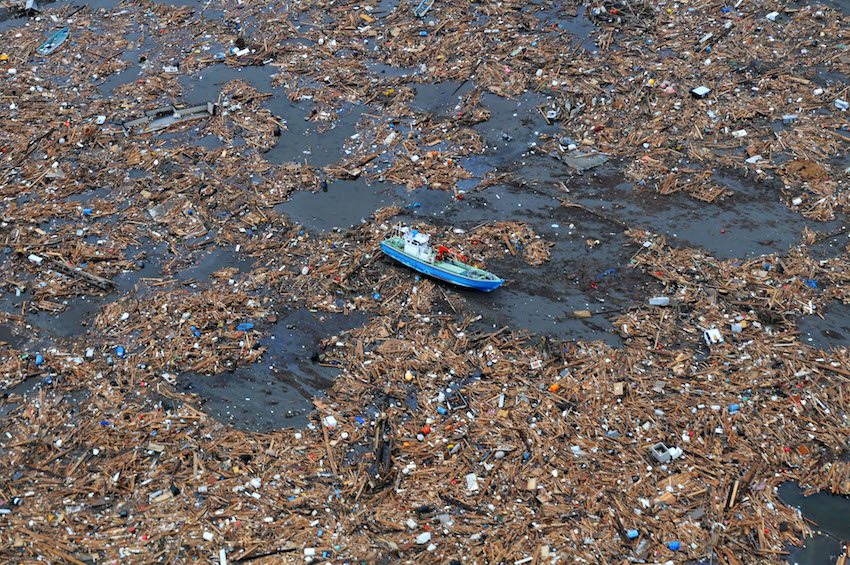
We’ve seen the horrible results of plastics that find their way to our oceans: floating garbage islands many meters across drifting with the currents; whales and other sea creatures dying with their bellies full of micro-bits of plastic that contaminate the plankton and krill the creatures use as food.

Lost in a sea of plastic garbage.
In the U.S., where plastics based on petrochemicals are ubiquitous, calling for reducing use of the material is a hard sell. Individuals can cut back on their own use of plastic at home, but the problem is bigger than that. Even municipal recycling programs are having a difficult time finding a market for their plastic now that China has stopped accepting it.

Technology, though, may provide part of the answer.  According to a post in Science Daily News, scientists at the U.S. Department of Energy's (DOE) Lawrence Berkeley National Laboratory have developed a new type of plastic that can be recycled by taking it apart at the molecular level, and putting it back together again in any shape, texture, and color. The process can be repeated again and again without loss of performance or quality. Discovery of the new material, called poly(diketoenamine), or PDK, was reported in the journal Nature Chemistry.

The PDK process strips plastic polymers down to their constituent monomers by dunking the material in an acid bath. This also allows for the removal of any additives that might have given the old material its color, flexibility, toughness or other special characteristics. The new material is like a basic building block that can be recombined in all sorts of new ways. PDK can be torn down and built back up multiple times, making it reusable in a circular process, not just a one-time linear process as is true of conventional plastics.

Peter Christensen, a postdoctoral researcher at Berkeley Lab's Molecular Foundry, was lead author of the study that announced the discovery. He admits, “Most plastics were never made to be recycled.” But that was before the team he was part of looked at recycling from “a molecular prospective.”

Christensen’s multidisciplinary team was led by Brett Helms, a staff scientist in Berkeley Lab's Molecular Foundry. The DOE/Lawrence Berkeley National Laboratory reports the other co-authors were undergraduate researchers Angelique Scheuermann (then of UC Berkeley) and Kathryn Loeffler (then of the University of Texas at Austin) who were funded by DOE's Science Undergraduate Laboratory Internship (SULI) program at the time of the study. The overall project was funded through Berkeley Lab's Laboratory Directed Research and Development program.

Team leader Brett Helms is clear about the potential impact of the discovery of PDK on our environmental future. "We're at a critical point where we need to think about the infrastructure needed to modernize recycling facilities for future waste sorting and processing," said Helms. "If these facilities were designed to recycle or upcycle PDK and related plastics, then we would be able to more effectively divert plastic from landfills and the oceans. This is an exciting time to start thinking about how to design both materials and recycling facilities to enable circular plastics." 

Cheers, Donna

*Information for this post taken from: “Plastic gets a do-over: Breakthrough discovery recycles plastic from the inside out,” Science Daily News, DOE/Lawrence Berkeley National Laboratory, May 7, 2019.  https://www.sciencedaily.com/releases/2019/05/190507110452.htm