
Showing posts with label special effects. Show all posts

Thursday, December 1, 2022

Bringing fantasy and science fiction to life


I've just returned from a fabulous nineteen-day trip to New Zealand. It's a beautiful country, full of wonderful scenery, glacier-carved valleys, fjords, forests, and unique animals. The iconic kiwi is in some ways closer to mammals than birds. It has two ovaries, not one. Its bones have marrow instead of the lightweight honeycomb bones of other birds. Like most flightless birds, it has the vestiges of wings so it did have them once. Oh - and its origins go back to Australia, not Gondwanaland. And did you know the Kea, the NZ mountain parrot, eats meat? No, neither did I.

Anyway, I digress.

We were staying in a hotel in Auckland with a bridge on the fifth floor over to the casino next door, so we went for an explore.

Oh my. 

We stepped out of the lift and I was staring at Bill, one of the mountain trolls in Peter Jackson's movie, The Hobbit. I'm a HUGE Tolkien fan. Adored the books, loved the movies. I felt I'd died and gone to heaven. I stared around at the other trolls (Tom and Bert) and found the entrance to the gift shop, dominated by Smaug the great red dragon. I found Gollum with a salmon, the dreaded Pale Orc with his axe raised, and shelves of models and collectables of superior quality. They were seriously good, beautifully made dioramas of iconic scenes from the movies. Forty years ago I would have gone home with a lighter wallet and a bulging suitcase. But this time I settled for going on the Weta Workshop Unleashed experience, which demonstrated the ways in which the Weta team brings fantasy to life. Peter, who had been ambling in my wake as I oohed and aahed and explained where that scene happened or who that character was, declined to come with me. He had better things to do, like watch grass grow. 

Philistine.

The black rider attacks Frodo


Gollum

 
The pale orc

The workshop isn't about the Lord of the Rings and The Hobbit: it's about how the people who work at Weta bring fantasy to life. The visit looks at three very different films, all just about ready to be released. Fauna is a horror film set in New Zealand. Age of the Ever-Clan is a fantasy movie which imagines what might have happened if that meteor hadn't wiped out the dinosaurs and they had evolved further. Origins, another New Zealand based movie, is science fiction involving a huge, alien robot.

A lot of the exhibit is useful for writers, showing how the techs and the directors set up for a scene. Here's an example. 
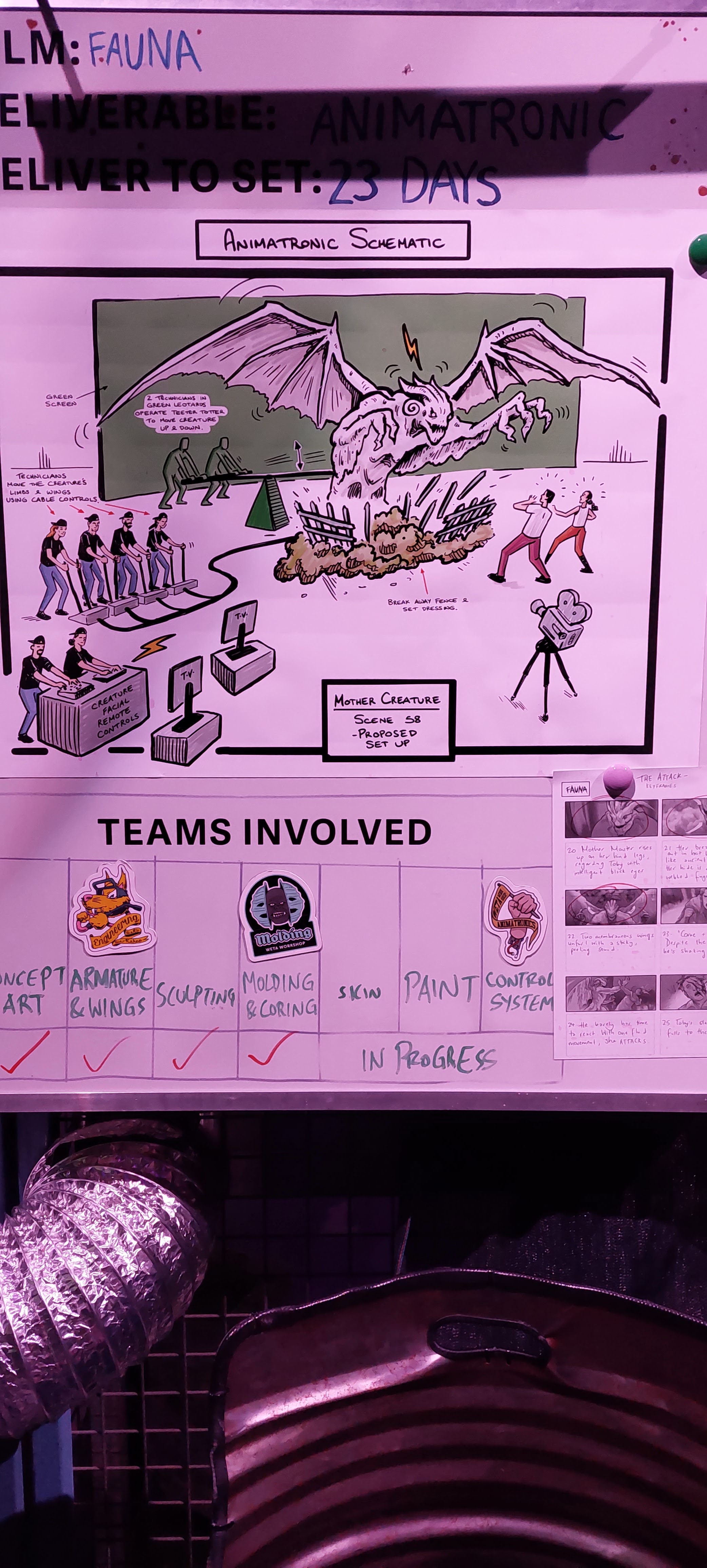

As part of telling us about the horror movie, Fauna, they’d set up a section of set where we could walk through a scary bit to give us a feel for how it all works. We were warned it would be dark and claustrophobic and small children and pregnant women shouldn’t enter. People went in as couples or as individuals with a gap between entrants so we could have the experience alone. Two young women went in before me but just as I was about to start, they came back looking seriously scared. No way were they going back in there. 

I girded my loins and set off. 

I walked along a boardwalk into thick forest just like the temperate rain forest you can find all over New Zealand. I couldn't hear the sounds of all the people I knew were out there. Foliage crowded the boardwalk and vines hung down around my face. I persevered and walked into a shed that seemed to be part of a slaughterhouse filled with hanging sheep carcasses and no obvious way to get out. I reckon that was where the two girls decided it was a resounding NUP.

And that was before I got to the scary bit, which I won't tell you about. Spoilers, you see.

I managed to get all the way through without panicking.

From Origins

The tour is very much hands-on. People are encouraged to try things out, to pull the levers that animate the models, play with chain mail, carve objects, press buttons, get involved. The kids on tour loved it and so did most of the adults.

If you're a fan of special effects you're sure to find this place fascinating. The website will introduce you to the nuts and bolts of how it works and how it's done from gory makeup to set dressing, to making realistic weapons, to models and everything else. 

Here's the website to give you a taste of movie magic.

Cheers,

Greta


Thursday, August 25, 2022

Light and Magic


I don't watch movies much – but when I do, they're almost always fantasy or science fiction. Way back then I enjoyed Star Wars: A New Hope but I was blown away when I saw The Empire Strikes Back. I loved the movie but I wanted to know how it was done. How did they do the spaceships? The light sabres? Yoda?

I subscribed to magazines that explained how the special effects were done. I learned that the interior of Darth Vader's flagship was mostly matte paintings, that Yoda was a puppet, that the Taun Tauns were done with stop motion animation and that the spaceships were all meticulously constructed models.Later, the producers added extra footage to their extended cuts explaining how it was done to give more information to geeks like me who care about these things. These days you don't even get that. Because it's all done with computers.

Which brings me to the point of this post.

I've watched (on the Disney Channel) a six-part documentary series about Industrial Light and Magic (ILM) which George Lucas created after A New Hope to keep together the bunch of technical and artistic whizz-kids he'd collected to create the movie's ground-breaking special effects. It's a series of interviews with those young whizz kids who were in their twenties in the seventies (like me) and are now in their seventies (like me). There's a lot of old footage of what they did back then and how they did it. We're talking about luminaries like Phil Tippet, the king of stop motion, Denis Muren, the ideas man, John Dykstra, who made cameras do what he wanted. Of, course, there's George Lucas who was a visionary, Joe Johnston who moved from SFX to directing, Ron Howard, Steven Spielberg and heaps of others. While Lucas was writing Empire and Jedi he allowed his director-friends to use ILM's services (eg Indiana Jones) so this wonderful bunch of creatives stayed together.

But there's so much more to this documentary than 'this is what we did'. It's about people, about why it all worked – and one important reason was it wasn't a huge corporation. Guys wore what they wanted, there was plenty of room for play, a family vibe, innovation was encouraged, none of that 'this is the way we've always done it'. And they all loved going to work.

George Lucas always wanted to use computers in his film making but using computer graphics (CGI) didn't sit well with the traditionalists. How do you create something new and artistic with a computer? The documentary shows how CGI was originally introduced. In fact, ILM created a machine called PIXAR to make CGI. Lucas sold the machines and the name to Steve Jobs, who had the money to invest in the fledgling company to make cartoons like Toy Story and Monsters Inc. Lucas kept to his aim of mixing CGI with real footage, which he did with the three Star Wars prequels.

And then came Spielberg's Jurassic Park. The CGI folks were convinced they could do the dinosaur magic. Phil Tippet and his model makers were sure the CGI guys couldn't do living, breathing, animals with a computer. Management agreed so they went ahead with filming with stop motion dinosaurs. But the CGI guys got hold of a miniature of a T-Rex skeleton and fed that into their CGI software. Then they showed the creature walking toward the camera – one of the hardest things to do. From there, the movie was done in CGI.

There's footage of the present-day Phil Tippet when he learnt that his work – almost finished – on Jurassic Park was replaced. It's many years ago now, but he was clearly shattered. His job was gone. But actually, it wasn't. Phil was an expert on how things moved, knowledge that was invaluable to the CGI animators. Lucas insisted he stay on. For some of the traditional animators and model makers moving to CGI was a bridge too far. But others made the switch, recognizing that the new technology was here to stay. ILM paved the way for Pixar and Weta Workshops.

The name of the documentary is Light and Magic. It's directed by Lawrence Kasdan who co-wrote a number of the Star Wars screenplays. (He's another person who was in his 20s in the seventies and is in his 70's in the twenties.) It's a series that has left me thinking about so many things long after the last credits rolled through.