Showing posts with label Netflix. Show all posts

Friday, December 2, 2022

EERIE SF/PARANORMAL/STEAMPUNK: 1899

A ship steams toward destiny in Netflix's 1899.

Just before we are swamped by television’s annual flood of holiday movies and specials, you might want to take a few nights to binge something completely different. Fans of steampunk and classic mad-scientist SF, in particular, will be fascinated by 1899, an eerie psychological paranormal thriller on Netflix from the German creators of Dark.

  I’ll admit I’m only about halfway through this limited series starring an ensemble of international actors (the dialogue is delivered in German, Polish, Cantonese, Spanish, Danish, French and I’m sure I missed a few languages) led by British actor Emily Beecham, but I’m definitely hooked. It’s a bit of a slow build, I don’t mind waiting for a show to reveal itself, as long as the characters are interesting (which they are in this case—everyone seems to have a secret and/or a painful past).

The basic premise is that a shipful of European immigrants—some richer on the upper decks, some poorer in steerage—are making the trip across the Atlantic on the symbolically named Kerberos (yes, the three-headed dog that guards Hades). The captain of the mostly German crew (played by Andreas Pietschmann) and his officers remark that, 1) they are grateful they weren’t laid off when the company was bought out by a British cruise line and, 2) they are cruising at only about half capacity in passengers and with no cargo.

Aboard the ship are a mix of odd characters, including a female doctor (Beecham) who specializes in the brain and has studied medicine, but not practiced (which was common at the time for women); two gay men posing as brothers, one of them a fake priest; a madam posing as an imperious society matron; a Chinese mother and her daughter, who is destined to join the madam’s brothel as a “geisha;” a devout Danish family in steerage, the oldest brother of whom is a target for one of the rich gay men and the oldest sister of whom is pregnant; and so on.

About a third of the way into the trip, the ship receives a repeating telegraph of coordinates from a ship of the same line (the Prometheus) that has been lost for four months. There are no other details. The captain determines they must change course to check it out. (I was suddenly reminded of STAR TREK, forced to investigate a mysterious emergency distress signal in the black of space.)

Now, what we have come to understand is that both the captain and the doctor have received black-edged letters from the same anonymous source urging them to investigate the cruise line (owned by the doctor’s father) and the disappearance of the (again symbolically named) Prometheus. On the back of the envelopes was this message: What was lost will be found again. And it’s useful to know that a black-edged envelope in Victorian times meant an announcement of death.

So, despite much grumbling from passengers and crew, the Kerberos is diverted to find the Prometheus. When they get there, they discover the abandoned ship, looking very decrepit (like it’s been abandoned much longer than four months), but no bodies and no evidence of what might have happened. They discover only one survivor—a boy of about eight, locked in a cabinet (from the outside). He doesn’t speak, but hands over to the doctor a pyramid-shaped black object with markings on it. No one has a clue what it is, but immediately all the compasses on the Kerberos go haywire. If it were me, I’d toss the thing overboard, but no one ever does, do they?

Also, while the Captain and his crew (and the doctor) are searching the Prometheus, a young man (Daniel Solace, played by Aneurin Bernard) swims aboard the Kerberos from the abandoned ship, fully clothed, boots and all, and finds an empty room to hide out in. He starts releasing scarabs (another symbol of death) in the ship, why we don’t know. But, pretty soon, people start dying; the captain and the doctor start having visions; and things start going south. (The scarabs, by the way, also unlock doors and portals to other worlds.)

When contacted for orders, the cruise line insists they sink the Prometheus, which is strange enough, but the Captain refuses and makes the decision to tow it back to their port of origin. Passengers and crew are all unhappy—several of the passengers have big reasons for not going back—and the crew fear their captain has lost his mind. But the Captain just knows something is wrong about that ghost ship, and he’s determined to find out what. But a mob blames the boy for the spate of deaths on the ship, chaos leads to mutiny, and Daniel Solace turns out to hold the key to some fearsome new tech on the Kerberos.

But that’s not the end to the wild and inexplicable events on the ship. Manipulation of the new tech places the Kerberos elsewhere, miles from where it had been, back on course for America and separated from the ill-fated Prometheus. Another push of a button starts up the ticking of a spectral clock which sends most of the passengers into a zombie-like state and over the side into the ocean. It’s only much later that we discover the cause of all this may be a mad scientist behind what is a massive mind experiment.

The show has a few faults, the biggest being that Beecham’s character, Maura Franklin (the doctor), is what we in the science fiction world call a Mary Sue. She should be just another passenger—well, with a few connections to the plot, certainly—but for some reason she manages to insert herself in all the action. That would never happen onboard a real ship. Still the show is worth a watch for fans of the paranormal, of steampunk (the Victorian setting, the gears and odd tech—Solace even wears a long coat and boots), and of classic mad scientist SF. They, like me, will want to tune in to find out what happens next in this twisty tale.

Cheers, Donna

Friday, August 26, 2022

GAIMAN'S THE SANDMAN ON NETFLIX NOW

The ethereal Tom Sturridge is The Sandman on Netflix.
British author Neil Gaiman is one of the most recognizable names in science fiction and fantasy today, with a plethora of books, plays, short stories and graphic novels to his credit. He began his run in 2008 by becoming the first author to win both the Newbery and Carnegie medals for the same book (The Graveyard Book) and continued with the Book of the Year from the British Book Awards in 2013 for The Ocean at the End of the Lane. He’s won the Hugo, the Nebula and the Bram Stoker award as well. And, if that weren’t all, he’s done well-recognized work in light-hearted SF/F television series (Lucifer, Doctor Who, Good Omens).

Speculation and anticipation ran rampant for years that a project was in the works to adapt Gaiman’s popular DC Comics graphic novel series, The Sandman. In 2019, Netflix acquired the property in a massive deal with Warner Brothers, which owns the DC universe. Given the world-building requirements of the mind-blowing fantasy, The Sandman took a while to bring into being. But August 5, we all saw the result of years of written adaptation, careful diversified casting and gorgeous art production and computer- generated imagery when the 11-episode show debuted on Netflix.

I have to admit I’m a “Sandman newbie,” never having had time to read the original graphic novels. But Gaiman has said the show is aimed at an audience more like me than Sandman superfans. He and his other creative collaborators, David S. Goyer (DARK CITY, DARK KNIGHT, BATMAN BEGINS) and Allan Heinberg (WONDER WOMAN), wanted to make sure the series and its many characters were accessible to viewers who tuned in out of curiosity, not just long-time readers of the comics. And they succeeded. I was instantly hooked by the characters and fell deeply into the world of The Sandman.

I was seldom confused or lost by the narrative, but it helps to know some Greek mythology (which comes up a lot in the show), a bit of the Bible, and a lot about supernatural arcana a la Sam and Dean Winchester. Yes, The Sandman has its own stable of beings with superpowers—not only Dream/Morpheus/The Sandman himself (an otherworldly Tom Sturridge) and his siblings Death (the beautiful Kirby Howell-Baptiste), Desire (a nonbinary Mason Alexander Park), Despair (a bedraggled Donna Preston) and the rest. But also Dream’s creations—Nightmares like The Corinthian (Boyd Holbrook) who takes his victims eyes, or Gault (Ann Ogbomo), who wants to stop haunting her humans’ dreams. There are also those who serve in Dream’s Realm—the Librarian, Lucienne, who takes over when he’s not around and serves as his conscience (Vivienne Acheampong), and Matthew the Raven (voiced by Patton Oswald), who serves as his eyes and ears in the waking world.

We first meet Dream in the series when an evil student of the occult, Sir Roderick Burgess (played by veteran actor Charles Dance), calls him forth in a ceremony really meant to capture Death. (Burgess has lost a son in WWI and wants him back.) When he recognizes his error, he takes Dream’s objects of power (his bag of sand, his helmet and a ruby amulet), the only one of which Burgess can use being the ruby, which makes dreams come true. But Burgess keeps insisting he wants immortality and won’t let Dream go until he gets it. Dream, in the meantime, says and does nothing. For a hundred years.

Dream’s captivity has all sorts of consequences—in the waking world, where thousands of people fall into a kind of coma called the “sleepy sickness” and don’t wake up, and in the Dreaming, his own Realm, where Nightmares escape to wreak havoc and the Realm itself begins to crumble. The objects of power, the ruby in particular, fall into the wrong hands and cause their own kind of chaos in the waking world until Dream can escape his captivity and recover them.

The first half of the show—roughly five episodes—busies itself with Dream’s quest to find his objects of power and undo some of the damage done during his time away from the Dreaming. This is based on the first volume of the graphic novels in The Sandman series, Preludes and Nocturnes. Volume Two in the series, The Dollhouse, provides the storyline for the last half of the show, minus the bonus episode at the end of the first season (more about that later).

As Dream returns to his Realm with his objects of power and begins the rebuilding of his Realm, some problems are left behind unresolved. Three Nightmares still roam the waking world: Gault, Fiddlers’ Green (played by Stephen Fry) and The Corinthian. Dream will have to corral these three and return them to their proper place in his Realm.

And a new problem has arisen, the development of a Dream Vortex, a powerful human that disrupts dreams and has the potential to collapse the waking and Dreaming worlds in on themselves. This being takes the form of a young woman, Rose Walker (Vanesu Samunyai), with a complicated backstory, a tragic childhood and a separation from her younger brother, Jed (Eddie Karanja). This serves to introduce a host of other colorful characters and send us on yet another quest to find Jed. The quest ends up at a serial murderers’ convention, of all places, where The Corinthian is the honored guest. The Corinthian is using Jed as bait, but it turns out he is the one caught as Dream finds him at last, Rose and Jed are reunited, and everyone discovers the Dream Vortex is not who we thought she was after all.

Most of this plot moves along at a steady pace, if not a blistering one. There are some unnecessary detours along the way as we meander through several characters’ dreams, which I assume are there to satisfy fans of the graphic novels. I gather from reading the reviews that quite a few characters from the novels were left out. I didn’t miss them, and, as you can tell from this review, there are more than enough characters already. But I assume there would be plenty of material for another season. Netflix has yet to make a determination on that score.

Finally, a word about Episode 11, the so-called bonus episode, which is comprised of two separate stories, “Dream of a Thousand Cats” and “Calliope.” The first is an animated story about a Siamese who is on a mission to restore the natural order of feline dominance over humans by rousing her fellow cats to dream a different reality. But have you ever tried to get a bunch of cats to cooperate?

The second story concerns two successive authors (Derek Jacobi and Arthur Darvill) who bind the muse Calliope (Melissanthe Mahut) to their will, keeping her captive for years so she will inspire them to write for fame and fortune. It takes the intervention of her former lover Dream to free her. This little tale has the tone of an episode of The Twilight Zone, with the desperation (and cruelty) of the writers turned back on them in typical Serling fashion.

Yet it’s difficult to see the connection of this bonus episode to the rest of the show, despite the presence of Dream in both. There is certainly no sequential connection to the plot. The Sandman doesn’t appear to be an anthology series, though it could have been set up that way. So this episode (and a couple of others, like “The Sound of Her Wings” and “24/7”) stick out as oddities. If the show gets a second season, which it deserves, seems to me the concept needs some clarification.

Cheers,

Donna


Friday, January 21, 2022

THREE TO STREAM FOR SF FANS

I haven’t had a chance to review any SF films in a while here on Spacefreighters Lounge. I’ve been saving all those opinions for my podcast, My Moviehouse My Rules, now housed on SoundCloud. But there are a few interesting new titles to stream right now that SF fans might want to check out.

Let’s start with a film that’s generating quite a lot of buzz on Netflix, DON’T LOOK UP, starring just about everybody in Hollywood, but most notably, Leonardo di Caprio, Jennifer Lawrence, Meryl Streep, Timothee Chalomet, Cate Blanchett, Tyler Perry, Mark Rylance, Jonah Hill, and Ron Perlman. Written and directed by Adam McKay, who wrote THE BIG SHORT and produced the Academy Award-winning VICE, this is a dark comedy about the end of the world, that demise coming in the form of a giant comet headed straight for Earth.

Two scientists, nerdy-but-attractive Dr. Randall Mindy (di Caprio in tweed and glasses) and impulsive-but-beautiful grad student Kate Dibiasky (Lawrence looking much as she always does), discover the comet and try to get someone, anyone, to listen to their message of looming disaster. To no avail. The politicians (including the President (Streep) and her idiot son/Chief of Staff (Hill) are too concerned about politics; the media (Perry and Blanchett) are too concerned about “keeping things light” on their talk show. An “Elon Musk”-type tech genius (Mark Rylance) delays destroying the comet in vain hopes of exploiting its precious rare-earth elements. All of this is played for laughs, but the premise cuts a little too close to the bone to be laugh-out-loud funny.

McKay’s sentiments are obviously skewed toward the liberal side here, which may lead some more conservative viewers to avoid the film. But DON’T LOOK UP is more pro-science than against any particular political faction, sympathizing with all the scientists currently crying in the wilderness about climate change.

I wasn’t expecting much from the film, given the poor reception it got from critics (who called it too preachy). Instead, I found DON’T LOOK UP unexpectedly touching, thanks to the filmmaker’s repeated use of a single technique to bring his point home. From the moment the news of the comet becomes known, he shows everyday people absorbing the information via their phones, TV screens and tablets, at first with mild interest, then with increasing alarm. McKay checks in with folks at home at key moments throughout the film, not just Americans or Europeans, either, but people gathered around TV sets in huts in Africa, in slums in India, on islands in the Pacific. As the comet comes nearer, some people are in active denial (thus the title of the film), some are glued to their screens. But finally the object of doom is impossible to ignore—the thing is like a searchlight in the sky.

As humanity’s end grows near, we are treated to images of all that would be lost if the powers that be do nothing and the comet hits: wildlife in forests and savannas, birds on the wing and fish in the ocean, babies and puppies and rushing streams. Just flashes, but enough to remind us what a treasure this Earth is, unlike anything else in this solar system; unlike anything else we know within reach in this galaxy. It becomes clear that McKay isn’t talking about the fictional, unlikely, planet-ending disaster of a comet striking us. He’s talking about global warming, something that is happening right now, the response to which is equally inadequate, too little and too late, hampered by politics and denial.

Timothee Chalamet’s character, the relapsed Christian evangelical skater-boy Yule, provides a tiny, flickering spark of hope near the end of the film when he offers up a prayer around the family dinner table as doom approaches. Far from being a saccharine moment, in Chalamet’s hands, it becomes another touching scene when you least expect it. And, yes, I’ll admit to a taste for good corn when the film calls for it.

Of course, SPOILER ALERT! there is a problem with this film if you like happy endings. There genuinely isn’t one here, unless you count what happens to the despicable President Orlean. But those are the times we live in. Contrast that with the optimism of 90s disaster films like ARMAGEDDON (Bruce Willis, Billy Bob Thornton, Ben Affleck) and DEEP IMPACT (Morgan Freeman, Elijah Wood, Robert Duvall). Yes, we lost lots of people and coastlines in those films, and heroes sacrificed their lives to save the world, but the world was saved in the end. And, perhaps more important, the citizens in those films trusted both science and their leaders. Just as we all did in those days. 

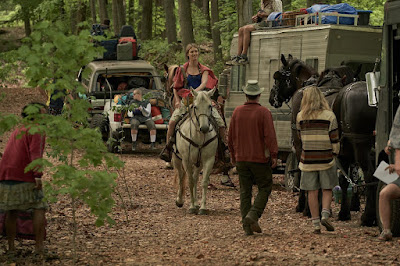
 Davis's troupe of players post-pandemic in Station Eleven.

The world does survive the apocalypse in a marvelously creative science fiction limited series streaming now on HBO Max, Station Eleven. I’ll leave it to you to decide whether you want to engage with a screen project that deals with the effects of a global pandemic (in this case a type of flu) that kills off most of the world’s population in just a few weeks. There are advantages in engaging in a fictional account of such a pandemic and its impact; you can remove yourself from it to a certain extent and see it objectively. And at least the pandemic in STATION ELEVEN isn’t a lingering thing like our COVID struggle. The premise here is that the flu blew through its host population quickly and was gone, leaving its small reservoir of immune survivors to carry on and rebuild civilization as they could.

In this series based on the novel by Canadian author Emily St. John Mandel, we follow the intersecting stories of a young girl, Kirsten (Matilda Lawler), who is onstage in a version of KING LEAR when all hell breaks loose; the man who, by chance, becomes her guardian, Jeevan (Himesh Patel); Kirsten 20 years later (Mackenzie Davis), now the unofficial leader of a troupe of Shakespearean actors wandering the wasteland of the Great Lakes region; and various other characters, all loosely connected by a pre-pandemic science fiction graphic novel they are each intimately familiar with titled STATION ELEVEN. The series jumps back and forth between characters and timelines to fill in gaps in the plot, assembling a full picture of what happened when and to whom, eventually giving us a complete three-dimensional model of how everyone (and everything) is related. It really is the most remarkable piece of storytelling, bolstered by some wonderful acting, stark camera work and a jarring electronic score. The show does require patience, however, and it may not be for everyone. If you like complex, though, (and you’re fond of SF and Shakespeare), I recommend it.

In a similar introspective vein comes a film advertised as science fiction, ENCOUNTER,  starring Riz Ahmed, star of 2019’s Oscar-winning SOUND OF METAL, backed up by versatile Oscar-winning actor Octavia Spencer. Amazon Prime chooses to describe this film by writer-director Michael Pearce as a science fiction tale about a Marine veteran trying to protect his two sons from the threat of an alien invasion. But SPOILER ALERT! at the risk of putting you off the movie, I’m going to tell you ENCOUNTER is NOT about that, except in the lead character’s mind. I guess the producers (and Amazon Prime) thought that if viewers knew it was about a mentally ill veteran of the Afghanistan war kidnapping his children and taking them across country under the delusion that microscopic bugs were controlling people’s minds, it might not go over so well.

So the setup puts us in the Marine’s mind, and, at first, we go along with the alien invasion idea. We see what appears to be something streaking into the atmosphere, what looks like a tiny tardigrade invading the bloodstream of insects, a mosquito injecting microscopic beasties into a human bloodstream, news reports of widespread rioting and crime on the television. We meet our antihero Malik (played with unstinting credibility by Ahmed—what a fine actor he is!) in a hotel room that appears to be crawling with nasty bugs. He’s covering himself with bug spray and “researching” the invasion. He’s also planning to grab up his two sons, 10-year-old Jay and 8-year-old Bobby, (played with skills beyond their years by Lucian-River Chauhan and Additya Geddada) from their mother’s house because he’s convinced Mom has been infected by the alien bugs.

What follows is a tragi-comic road trip from Oregon to Nevada’s Groom Lake, where Malik believes the last uncorrupted base still holds out against the invasion. Meanwhile, the FBI is on his trail, thinking he is a “family annihilator,” someone who will kill his boys and himself when he finally snaps. Only his parole officer (Octavia Spencer), a good-hearted type who gives everyone the benefit of the doubt, believes he will put his sons before himself.

The power of the acting is what lifts this admittedly strange and clunky vehicle out of the mud. Ahmed and both boys take the mundane to the next level here, making ENCOUNTER worth watching. And the end, far from being the disaster you might anticipate, is touching and even uplifting. I started watching this because I like Ahmed and I expected SF; I stayed with it because it had surprising depth. You might, too.

You can find these and more of my new screen reviews with old-school attitude on SoundCloud, iTunes, Stitcher, my Facebook Page app or on my podcast website at mymoviehousemyrules.com. You can comment there, too, and tell me what you think!

Cheers, Donna