Showing posts with label SF film reviews. Show all posts

Friday, September 2, 2022

PEELE'S NOPE LOTS TO UNPACK

Daniel Kaluuya is haunted by a UFO in NOPE.

The best science fiction and horror tales don’t just describe weird monsters from another world or a supernatural dimension. They investigate those bloodthirsty veins of dark emotion in our souls—fear, greed, hatred, bigotry, jealousy. Stephen King understands this, as did Rod Serling before him and a whole host of the New Wave SF writers.

Jordan Peele is their inheritor in film these days, and his latest SF/horror mashup, NOPE, is a perfect example of how the external alien monster is just a projection of the human victims’ inner demons. Oh, it’s scary enough—and the special effects make it eerily beautiful to look at once it shows up in its full, day-lit glory—but the truly frightening stuff in Peele’s film is found in the hearts of some of his human characters.

This is a dense film, full of symbolism and lots of Easter eggs for film fans, SF fans and horror fans alike. I enjoyed putting together all its puzzles, but I will admit I needed to do a little research online to help me figure a few things out. If I’d had time, I would have just watched it again. I don’t agree with critics who have called it disorganized. That is most definitely not the case; there is just a lot to absorb here on one viewing.

Let’s start with the title, NOPE, which is the typical reaction from both Black folks facing a dubious situation and anyone who runs screaming from the idea of watching a horror movie. (I have a few of those friends.) Peele is playing off both those cliches in his title, and he makes use of the quote multiple times in the film, too, when his Black protagonists see something scary, in much the way we Southerners might say, “Oh, hell no!” But there are a lot of online commenters who insist the title stands for NOT OF THIS EARTH, giving us a hint of what’s to come in the film.

Peele has plenty to say in the film, starting with a quote at the beginning from the Bible’s Book of Nahum: I will cast abominable filth upon you, make you vile, and make you a spectacle. Though that’s not a particularly familiar Old Testament verse, the word spectacle is key to what Peele is trying to get to in NOPE—that we humans will do just about anything, pay just about any price, to watch a sufficiently entertaining spectacle. We’ll rubberneck an accident on the highway, watch “contestants” backstab each other to win the affection of THE BACHELOR, seek out gory slasher movies, and laugh at wipeouts on silly TV obstacle races or RIDICULOUSNESS videos. And some folks will do much, much worse on YouTube.

In NOPE, Peele focuses his lens (and his symbolism) primarily on animals as the unhappy subjects of these spectacles, and the consequences of exploiting trained animals (like horses and chimpanzees) for our amusement. But that’s just a plot device that allows him to say something about the exploitation of people of color and/or the lower classes for the benefit of white, upper-class society. All of which could be tedious in the extreme if Peele weren’t such an entertaining filmmaker, and this film weren’t full of action, jump scares, cool special effects and great acting from principal actors Daniel Kaluuya, Keke Palmer and Stephen Yuen.

But what is the film about? Well, briefly, it’s about the Haywood siblings (Kaluuya and Palmer), who have just inherited a failing ranch in the California hills that trains horses for the Hollywood film industry. As Palmer’s character puts it, “Since pictures began to move, we’ve had skin in the game.” Close to bankruptcy, they’ve been forced to start selling off the horses to the owner of a neighboring theme park, Jupe’s Claim (Yuen), who, it turns out, is putting them to a nefarious use. When a UFO starts stalking the remote valley, all parties try taking advantage of what they see as an opportunity. It’s useful to remember that opening quote, though, and the idea that wild things can’t be controlled.

It's difficult to say anything more without giving everything away. (Hear my spoiler-y complete review here.) NOPE may not be the simple, straightforward science fiction/horror mashup that audiences expect, but it’s chock full of great characters, interesting ideas, thoughtful themes, eye-popping effects and dark humor. Keep your mind engaged, and I guarantee you’ll enjoy it.

Cheers, Donna

Friday, April 8, 2022

SF STAR WILLIS EXITS THE SCREEN

Bruce Willis as Korben Dallas, THE FIFTH ELEMENT.
Some of our screen heroes seem to last forever, like the virtually invincible Bill Shatner, 91 years old and still going strong. Others, sadly, are only impervious to harm in the movies, like the star of many a science fiction classic, Bruce Willis. We got the news this week that Willis is retiring from his acting career of just over 35 years due to a diagnosis of aphasia, or, as my dictionary defines it, the inability to understand or produce speech.

Aphasia is usually the result of brain damage caused by trauma, illness or stroke. His family has not announced details about the cause or prognosis of his condition. But it is known that he sued Revolution Studios for unspecified damages related to a blow to his forehead that he received during "ultrahazardous activity" involved in the filming of TEARS OF THE SUN in 2003. The suit claims the injury has caused him extreme mental, physical and emotional pain and suffering. Film producers and directors working with Willis on recent projects have noted he’s had difficulties remembering his lines and was disoriented onset, despite accommodations made to help him.

Whatever the cause of his decline, I’ve been a fan of Willis’s since his days playing private eye David Addison opposite Cybill Shephard in television’s Moonlighting (which ran on ABC from 1985 to 1989), the role which launched his career and garnered him an Emmy and a Golden Globe. And Willis is two years younger than I am. So this one kinda hit me hard.

Of course, even before his five-year stint on Moonlighting ended, Willis had begun his wildly successful career as an action film star with DIE HARD in 1988. That film spawned four sequels and a handful of video games, as well as being selected for preservation in the National Film Registry in 2017 by the United States Library of Congress as a "culturally, historically, or aesthetically significant" film.

In the first of his collaborations with director Quentin Tarantino, Willis played an aging boxer in the pay of mob boss Ving Rhames in 1994’s PULP FICTION. He brought his trademark combination of toughness and vulnerability to the role, giving the character of Butch, in love with his air-headed girl and just trying to survive at the ignominious end of a boxing career, a pathos he might not otherwise have had. It may be hard to watch this performance now in light of Willis’s own deteriorating mental condition. The actor starred in two other Tarantino-adjacent projects, Robert Rodriguez’s SIN CITY (2005) (an adaptation of a Frank Miller graphic novel) and the Tarantino/Rodriguez collaboration GRINDHOUSE/PLANET TERROR (2007), both of which featured the highly stylized cinematography, dystopian vision and over-the-top violence that is the hallmark of both directors’ grindhouse style.

For science fiction film fans like me, it’s that kind of work in our favorite genre that will live on beyond any of his other creative efforts. Several of his roles are iconic; the films themselves are cult classics; and, like SIN CITY, the stories they portray are popular across several media. Take the first of these films, 12 MONKEYS, from 1995, directed by Terry Gilliam and costarring Brad Pitt and Madeline Stowe. This story of a convict (Willis playing James Cole) sent back in time to investigate the sources of a virus that has wiped out 99 percent of the human population, garnered an Oscar nomination for Pitt, and spun off a successful television show of the same name on the Syfy Channel from 2015 to 2018.

Then there is THE FIFTH ELEMENT (1997), helmed by well-known SF director Luc Besson and costarring Gary Oldman and a host of others. The plot of this futuristic mashup is mostly nonsense (Willis plays taxi driver/former commando Korben Dallas), but the effects are a delight for the eyes and the film has become a favorite of SF fans.

The disaster/action film ARMAGEDDON from 1998 has much broader appeal, with a cast drawn from Hollywood A-listers like Willis, Ben Afleck, Liv Tyler, Billy Bob Thornton, Will Patton and others. Plus, though the plot has more holes than a block of Swiss cheese, it was written by Jonathan Hensleigh (of DIE HARD fame) and J.J. Abrams (of too many films to count) and directed by action king Michael Bay. NASA shows this film about a mission to divert a killer asteroid by drilling into it and setting off nuclear explosives to blow it to bits to its managers in training for them to spot the errors. Spoiler alert: There are a lot of them.

Willis’s next film was a complete departure from his work in action movies. As child psychologist Malcolm Crowe in M. Night Shyamalan’s THE SIXTH SENSE he is subdued, empathetic, even, as his film client (Cole Sears, played by the astounding Haley Joel Osment) notes, “sad.” But he is determined to help Cole, who “sees dead people,” even at the risk of sacrificing his troubled marriage (to an equally depressed Olivia Williams), to gain redemption for a patient who committed suicide in his home at the beginning of the film (a young and nearly unrecognizable Donnie Wahlberg). This is a great film with a twist that gets me even with repeated viewings and offers possibly Willis’s best performance ever.

That is a tough call, though, when put up against his work in another Shyamalan film, UNBREAKABLE, from 2000. I love this film for its exploration of the comic book tropes of the invincible superhero (with a key vulnerability)—in this case Willis’s character David Dunn, who is impervious to injury, but vulnerable to water—and his corresponding nemesis, Elijah Price (Samuel L. Jackson), who was born with osteogenesis imperfecta, or brittle bone syndrome. The film was the first of Shyamalan’s so-called “Eastrail 177” trilogy, which includes SPLIT (2016) starring James McAvoy as serial killer Kevin Crumb, and GLASS (2019) which brings all three characters together in a grand finale. Again, Willis owns this role by underplaying it, bringing a sort of baffled “why me?” resignation to his newfound abilities, hoping to avoid notice for his good deeds.

Finally, I should mention Willis’s role in the best conception of time travel on film, 2012’s LOOPER, costarring Joseph Gordon-Levitt and Emily Blount. I’ve seen dozens of films about time travel and virtually all of them gave me a headache. But LOOPER is the one film I’ve seen where a time paradox is acknowledged and resolved in a most satisfying way. Kudos to writer/director Rian Johnson for developing something that is rare in Hollywood—an original idea. Willis plays the older version of Gordon-Levitt’s time-traveling gun-for-hire character in this film and brings the proper world-weariness to the role.

After GLASS in 2019, Willis continued to work at a frenetic pace, but in mostly B-grade actioners, voiceover work, shorts and cameos. He made nine films in 2021, none of them of any particular note, one of them so bad it was worthy of a special Razzy Award (which has since been withdrawn due to his disability). Despite his problems, he has completed eight more films for release later this year and next.

Bruce Willis has created an incredible body of work over a relatively short career. Maybe he just has an impressive work ethic. Or maybe something was pushing him to produce as much as he could before Fate took a hand. In any case, those of us who love the movies—especially science fiction movies—will be the ones who benefit. Thank you, Bruce, for all you have given us.

Cheers, Donna


Friday, January 21, 2022

THREE TO STREAM FOR SF FANS

I haven’t had a chance to review any SF films in a while here on Spacefreighters Lounge. I’ve been saving all those opinions for my podcast, My Moviehouse My Rules, now housed on SoundCloud. But there are a few interesting new titles to stream right now that SF fans might want to check out.

Let’s start with a film that’s generating quite a lot of buzz on Netflix, DON’T LOOK UP, starring just about everybody in Hollywood, but most notably, Leonardo di Caprio, Jennifer Lawrence, Meryl Streep, Timothee Chalomet, Cate Blanchett, Tyler Perry, Mark Rylance, Jonah Hill, and Ron Perlman. Written and directed by Adam McKay, who wrote THE BIG SHORT and produced the Academy Award-winning VICE, this is a dark comedy about the end of the world, that demise coming in the form of a giant comet headed straight for Earth.

Two scientists, nerdy-but-attractive Dr. Randall Mindy (di Caprio in tweed and glasses) and impulsive-but-beautiful grad student Kate Dibiasky (Lawrence looking much as she always does), discover the comet and try to get someone, anyone, to listen to their message of looming disaster. To no avail. The politicians (including the President (Streep) and her idiot son/Chief of Staff (Hill) are too concerned about politics; the media (Perry and Blanchett) are too concerned about “keeping things light” on their talk show. An “Elon Musk”-type tech genius (Mark Rylance) delays destroying the comet in vain hopes of exploiting its precious rare-earth elements. All of this is played for laughs, but the premise cuts a little too close to the bone to be laugh-out-loud funny.

McKay’s sentiments are obviously skewed toward the liberal side here, which may lead some more conservative viewers to avoid the film. But DON’T LOOK UP is more pro-science than against any particular political faction, sympathizing with all the scientists currently crying in the wilderness about climate change.

I wasn’t expecting much from the film, given the poor reception it got from critics (who called it too preachy). Instead, I found DON’T LOOK UP unexpectedly touching, thanks to the filmmaker’s repeated use of a single technique to bring his point home. From the moment the news of the comet becomes known, he shows everyday people absorbing the information via their phones, TV screens and tablets, at first with mild interest, then with increasing alarm. McKay checks in with folks at home at key moments throughout the film, not just Americans or Europeans, either, but people gathered around TV sets in huts in Africa, in slums in India, on islands in the Pacific. As the comet comes nearer, some people are in active denial (thus the title of the film), some are glued to their screens. But finally the object of doom is impossible to ignore—the thing is like a searchlight in the sky.

As humanity’s end grows near, we are treated to images of all that would be lost if the powers that be do nothing and the comet hits: wildlife in forests and savannas, birds on the wing and fish in the ocean, babies and puppies and rushing streams. Just flashes, but enough to remind us what a treasure this Earth is, unlike anything else in this solar system; unlike anything else we know within reach in this galaxy. It becomes clear that McKay isn’t talking about the fictional, unlikely, planet-ending disaster of a comet striking us. He’s talking about global warming, something that is happening right now, the response to which is equally inadequate, too little and too late, hampered by politics and denial.

Timothee Chalamet’s character, the relapsed Christian evangelical skater-boy Yule, provides a tiny, flickering spark of hope near the end of the film when he offers up a prayer around the family dinner table as doom approaches. Far from being a saccharine moment, in Chalamet’s hands, it becomes another touching scene when you least expect it. And, yes, I’ll admit to a taste for good corn when the film calls for it.

Of course, SPOILER ALERT! there is a problem with this film if you like happy endings. There genuinely isn’t one here, unless you count what happens to the despicable President Orlean. But those are the times we live in. Contrast that with the optimism of 90s disaster films like ARMAGEDDON (Bruce Willis, Billy Bob Thornton, Ben Affleck) and DEEP IMPACT (Morgan Freeman, Elijah Wood, Robert Duvall). Yes, we lost lots of people and coastlines in those films, and heroes sacrificed their lives to save the world, but the world was saved in the end. And, perhaps more important, the citizens in those films trusted both science and their leaders. Just as we all did in those days. 
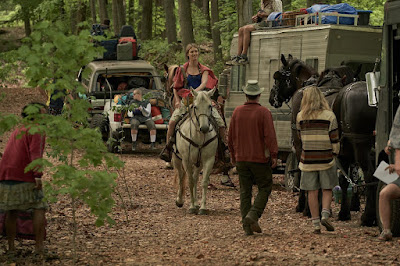
 Davis's troupe of players post-pandemic in Station Eleven.

The world does survive the apocalypse in a marvelously creative science fiction limited series streaming now on HBO Max, Station Eleven. I’ll leave it to you to decide whether you want to engage with a screen project that deals with the effects of a global pandemic (in this case a type of flu) that kills off most of the world’s population in just a few weeks. There are advantages in engaging in a fictional account of such a pandemic and its impact; you can remove yourself from it to a certain extent and see it objectively. And at least the pandemic in STATION ELEVEN isn’t a lingering thing like our COVID struggle. The premise here is that the flu blew through its host population quickly and was gone, leaving its small reservoir of immune survivors to carry on and rebuild civilization as they could.

In this series based on the novel by Canadian author Emily St. John Mandel, we follow the intersecting stories of a young girl, Kirsten (Matilda Lawler), who is onstage in a version of KING LEAR when all hell breaks loose; the man who, by chance, becomes her guardian, Jeevan (Himesh Patel); Kirsten 20 years later (Mackenzie Davis), now the unofficial leader of a troupe of Shakespearean actors wandering the wasteland of the Great Lakes region; and various other characters, all loosely connected by a pre-pandemic science fiction graphic novel they are each intimately familiar with titled STATION ELEVEN. The series jumps back and forth between characters and timelines to fill in gaps in the plot, assembling a full picture of what happened when and to whom, eventually giving us a complete three-dimensional model of how everyone (and everything) is related. It really is the most remarkable piece of storytelling, bolstered by some wonderful acting, stark camera work and a jarring electronic score. The show does require patience, however, and it may not be for everyone. If you like complex, though, (and you’re fond of SF and Shakespeare), I recommend it.

In a similar introspective vein comes a film advertised as science fiction, ENCOUNTER,  starring Riz Ahmed, star of 2019’s Oscar-winning SOUND OF METAL, backed up by versatile Oscar-winning actor Octavia Spencer. Amazon Prime chooses to describe this film by writer-director Michael Pearce as a science fiction tale about a Marine veteran trying to protect his two sons from the threat of an alien invasion. But SPOILER ALERT! at the risk of putting you off the movie, I’m going to tell you ENCOUNTER is NOT about that, except in the lead character’s mind. I guess the producers (and Amazon Prime) thought that if viewers knew it was about a mentally ill veteran of the Afghanistan war kidnapping his children and taking them across country under the delusion that microscopic bugs were controlling people’s minds, it might not go over so well.

So the setup puts us in the Marine’s mind, and, at first, we go along with the alien invasion idea. We see what appears to be something streaking into the atmosphere, what looks like a tiny tardigrade invading the bloodstream of insects, a mosquito injecting microscopic beasties into a human bloodstream, news reports of widespread rioting and crime on the television. We meet our antihero Malik (played with unstinting credibility by Ahmed—what a fine actor he is!) in a hotel room that appears to be crawling with nasty bugs. He’s covering himself with bug spray and “researching” the invasion. He’s also planning to grab up his two sons, 10-year-old Jay and 8-year-old Bobby, (played with skills beyond their years by Lucian-River Chauhan and Additya Geddada) from their mother’s house because he’s convinced Mom has been infected by the alien bugs.

What follows is a tragi-comic road trip from Oregon to Nevada’s Groom Lake, where Malik believes the last uncorrupted base still holds out against the invasion. Meanwhile, the FBI is on his trail, thinking he is a “family annihilator,” someone who will kill his boys and himself when he finally snaps. Only his parole officer (Octavia Spencer), a good-hearted type who gives everyone the benefit of the doubt, believes he will put his sons before himself.

The power of the acting is what lifts this admittedly strange and clunky vehicle out of the mud. Ahmed and both boys take the mundane to the next level here, making ENCOUNTER worth watching. And the end, far from being the disaster you might anticipate, is touching and even uplifting. I started watching this because I like Ahmed and I expected SF; I stayed with it because it had surprising depth. You might, too.

You can find these and more of my new screen reviews with old-school attitude on SoundCloud, iTunes, Stitcher, my Facebook Page app or on my podcast website at mymoviehousemyrules.com. You can comment there, too, and tell me what you think!

Cheers, Donna