 |
| A glimpse of Paradise from Amazon's LOTR: TROP |
Well, the biggest screen news this week has to be the debut of Amazon Prime’s lush and outrageously expensive return to the fantasy world of Middle-earth with LORD OF THE RINGS: THE RINGS OF POWER. I’ve been a Tolkien fan since I read the LOTR trilogy for the first time at the age of 16. (I’ve re-read the books every couple of years or so since then.) I loved the LOTR films by Peter Jackson, and I regularly re-watch those, too.
So, I was anxiously awaiting this debut to see what newbie producers and creators J.D. Payne and Patrick McKay would come up with from the limited source material of, basically, Tolkien’s appendices. Jeff Bezos’s Amazon, despite extensive negotiation with the Tolkien estate and his own personal participation in the bidding war with Netflix for the rights to this series (which may or may not have helped), was not able to get the rights to the author’s detailed history of the early ages of his fantasy world, The Simarillion. (That book includes the tale of Beren and Luthien, the original human/Elf love affair of which Aragorn sings in FELLOWSHIP OF THE RING and would have made great screen drama.)
On the other hand, obtaining even limited rights allowed the showrunners and writers to set their series in Tolkien’s familiar landscape of characters and places, with an overarching theme and premise around which to tell new stories. As the title suggests, their ultimate goal is to tell the tale of the forging of the rings of power (three for the Elves, seven for the Dwarves, nine for Men, and, of course, the One Ring to Rule Them All), but there is plenty of room for elaboration. (Why, for example, do the High Elves still wear their rings if they know Sauron had a hand in their making?) Think of it as a kind of fan fiction, but with a half-a-billion-dollar budget to work with. (And, yes, that’s billion, with a B. At the end of the planned five seasons, this will be the most expensive television series ever made.)
The new series, which debuted with two episodes on September 2, is set thousands of years before the time of Tolkien’s LOTR trilogy. During this so-called Second Age, the Elves and the Men of the great island kingdom of Numenor joined together to defeat the evil of that time, Morgoth. But in that war, his disciple, Sauron, escaped.
Young Elf warrior Galadriel (Morfydd Clark in the role that Cate Blanchett once owned) vows to take up the search on behalf of her brother Finrod (Will Fletcher), who died in its pursuit. She eventually becomes leader of the Northern Armies for Elf king Gil-Galad (Benjamin Walker), believing strongly that Sauron is still lurking in Middle-earth somewhere. But her quest finds only an abandoned forge at the top of the world, and, after many years, the king commands her to give it up. Even her friend Elrond Half-Elven (Robert Aramayo), a minor advisor in the court, suggests she’s taken her search too far. So when the king declares victory over Morgoth and Sauron and rewards his remaining troops (including Galadriel) with a trip to the Undying Lands in the West, she reluctantly agrees to go. At least until the very last minute, when she jumps ship to go back to the fight in Middle-earth.
Galadriel has always been one of the more interesting characters in Tolkien’s universe, and, in this prequel, we have a hint of the person she later becomes. As a young Elf she is impulsive, passionate, a fighter, someone who is willing to sacrifice herself and others for her cause. After she abandons her trip to Paradise, she encounters and overcomes one challenge after another in her pursuit of evil. It’s easy to understand the temptation the older Galadriel feels when presented with the One Ring, that she might be “more terrible than the dawn,” and that “all will love me and despair.” It will be fascinating to watch her grow during the series, as long as the writers, and the actor, can continue to clear that high bar.
The same is true of the character of Elrond, though I’m not as happy with the casting of Aramayo in the role. We do see hints of Elrond’s later caution and hesitation to do what is necessary to defend Middle-earth by allying with Men. Though I think it would be more helpful, particularly for Tolkien newbies, to address outright why Elrond is treated shabbily in the Elven High Court. (He’s only half-Elven, you see). Though maybe that will come later. His background could be his motivation for being reluctant to ally himself with Men. If so, we need to know it.
The benefits of prequel foreshadowing are much more obvious when we turn to the ancestors of the Hobbits, the migratory and secretive Harfoots. Though it is true the writers come uncomfortably close to stereotype territory in giving the Harfoots bad Irish accents and a tendency to vanish like legendary leprechauns, I confess I found them charming and fun to watch, much like their more playful descendants, Merry and Pippin.
And, just like the Hobbits Bilbo and Frodo, there is a Harfoot with an unusually curious and adventurous nature, Nori Brandyfoot (Markella Kavenagh), who isn’t content to gather berries and weave baskets with the rest of her folk. She wants to know what is beyond the range of their “wandering;” Who’s out there? What is there to see? Her elders tell her to mind her place, of course. The larger world is dangerous for their kind. Better to stay hidden.
But then, as will happen many thousands of years later, the larger world comes to them, in the form of what appears to be a meteor crash-landing in a nearby field. Nori and a friend go to explore, and find an unconscious, naked “giant” in the center of the impact crater (the unnamed “Stranger” played by Daniel Weyman). So far, the Stranger is incapable of speech, but his attempts to communicate create energetic chaos. Except when he whispers to fireflies in, um, firefly language. Hmm. Somewhat reminiscent of a certain wizard who murmurs to moths to call up a ride on a giant eagle.
In the first episode, we are also introduced to Arondir (Ismael Cruz Cordova), an Elf warrior posted in a remote village of Humans in the South of Middle-earth. His outpost was established to maintain watch over a cohort of Humans who were once allied with Morgoth and thus are considered unreliable. Arondir has been pining for a local healer, Bronwyn (Nazanin Boniadi), for years, though it is a forbidden relationship, and he has done little but speak a few words to her at the village well. Elf king Gil-Galad has declared the long war with the forces of evil over now, though, and the outpost is about to be withdrawn when mysterious poisonings occur, and an unknown terror burns a nearby village to the ground. Arondir goes to investigate and, well, things don’t end happily. Then there is the evil artifact that Bronwyn’s son Theo (Tyroe Muhafidin) has stolen from a nearby barn, bearing the sign of Sauron.
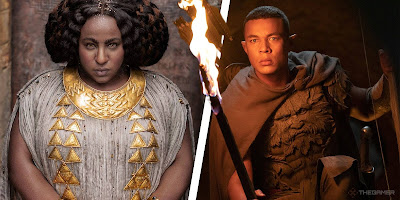
Most of the first episode introduces us to the main characters and sets up the premise. We don’t meet some major players until Episode Two, however. That would be the Dwarf prince Durin IV (Owain Arthur), heir to the throne of King Durin III, and his wife Princess Disa (Sophia Nomvete), in Khazad-Dum, an under-mountain stronghold previously seen only as a haunted, Orc-infested ruin in Jackson’s FELLOWSHIP OF THE RING. If there was nothing else worthy of watching in these two episodes (and, trust me, there is plenty), the scenes of Khazad-Dum in all its glory would make them worthwhile. In Jackson’s film, Gimli asks us to use our imaginations to think of the dank caverns as they once were in their heyday, but now we don’t have to imagine them; we can see them. And they are fabulous.
The excuse we have for visiting is a diplomatic mission to the Dwarf kingdom by Elrond on behalf of Gil-Galad’s celebrated smith, Celebrimbor (Charles Edwards), seeking technical assistance in building a new forge that will generate the “heat of a dragon’s tongue.” Just an aside here—we know that such a forge was used to create weaponry like the sword Narsil (which was shattered taking the Ring from Sauron’s finger and re-forged for Aragorn’s use). The question remains as to whether this forge was used to create any Ring of Power.
Elrond and the prince once were friends, but Elrond (as the long-lived Elves are wont to do) neglected the friendship, and he must first overcome Durin’s hurt feelings. (Those Dwarves are so sensitive!) We have hints of the roots of the falling-out between Dwarves and Elves, here, too, an enmity that Gimli and Legolas eventually healed.
While we’re on the subject of the Dwarves, we might as well talk about trolls, too. That is, the trolls that have stalked this production of the fantasy series practically from the beginning. There is a certain element of the fantasy fan base (and we might as well own it, of the science fiction fan base, too) that is openly racist and sexist when it comes to their beloved content. “Elves” (or Dwarves, or Hobbits, or aliens or captains of starships) can’t be Black! they say. Only Orcs (or bad guys) can be Black! And what’s with all these female lead characters? The heroes of fantasy and science fiction are supposed to be heroes! That is, males (and preferably young, white males). The casting of Black actors as a lead Elf and a lead Dwarf (as well as several Harfoots) drew howls of rage from the usual suspects online. Okay, and I’m only going to say this once, it’s fantasy, people. Elves and Dwarves and Harfoots aren’t real. They can be purple if we imagine them so. And the folk who carry the story can be any sex at all. Or no sex. Or all sexes. Just ask Ursula LeGuin, for one, and she was writing 60 years ago.
Fantasy (and science fiction) is for everyone, no matter your race, color, gender or any other sort of definition. Now, can we all relax and enjoy the show?
Cheers, Donna