Showing posts with label Star Trek. Show all posts

Saturday, August 6, 2022

RIP NICHELLE NICHOLS


Nichelle Nichols as Uhura

I’m actually on vacation this week with my daughter and granddaughter here in North Carolina with us (which accounts for the delay in posting), but I couldn’t let the week pass without mentioning the passing of television pioneer and science fiction icon Nichelle Nichols. 

As Nyota Uhura, Communications Officer of the Federation Starship Enterprise, Nichols broke new ground for Black actors in the Sixties, inspiring generations of young Black women to follow in her footsteps in both acting and space exploration. Most of you know those stories about her, so I won’t repeat them. (If you aren’t familiar, I urge you to look her up.) I do, however, have a personal memory of her to share.

Years ago, my young daughter Jessie and I were at the Shore Leave Science Fiction Convention in Towson, Maryland where Nichols was a featured guest. The autograph line was long and cost a bit, so I sent Jessie, who was 13 at the time, to meet Nichols and get her autograph. But I put Jessie up to a joke: “Ask Nichelle to do an imitation of Bill Shatner while you’re up there!”

Nichols had just done her “show” at the con, with lots of imitations, so I thought she might be up for it. And, sure enough, when Jessie got to the star, I heard a big laugh echo through the convention hall. “Oh,” Nichols said, hand on her chest, “I—couldn’t—do—that—to my—friend!” In perfect Shatner style. Hilarious!

The next time I saw Nichols at Shore Leave she was still smiling, but was in a wheelchair, beginning to suffer the effects of dementia and stroke. It’s consoling to think of her exploring new galaxies in infinite space, healthy and happy once more. RIP Nichelle and thank you.


Sadly, Donna 

Friday, May 13, 2022

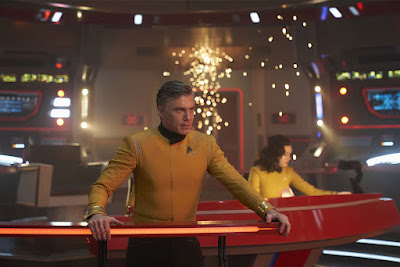
PIKE BEATS PICARD IN NEW TREK MATCH

Anson Mount is Captain Christopher Pike
Today let’s go where plenty of folks have been before and talk about the latest iteration of Gene Roddenberry’s science fiction media phenomenon, Star Trek. The little series that could first aired on NBC in September,1966 as what is now known as The Original Series and survives today on the streaming service Paramount Plus as several separate ongoing series, two of which I’ll talk about in this post.

Longtime readers of this blog already know I’ve been a fan of Star Trek since the early days of its debut on broadcast television. But I’ve always been an Original Series fan. In any discussion of who makes the Best Captain in Trek, Kirk has always won out over any of the later captains—Picard, Sisko, Janeway, Archer or the next-to-latest, Michael Burnham of Star Trek: Discovery (played by Sonequa Martin-Green).

That opinion was not challenged by watching the two available seasons of Star Trek: Picard on Paramount Plus, which I watched even though I’m not a fan of Star Trek: The Next Generation. I have become a fan of Patrick Stewart as a person, though, and the show also features Jeri Ryan, as Seven of Nine, from Star Trek:Voyager, along with Alison Pill, Michelle Hurd, Santiago Cabrerra, and Orla Brady as the other appealing secondary characters.

Guinan, the wise alien bartender from ST:TNG (played in her later years by Whoopi Goldberg, as a younger person by Ito Aghayere) makes an appearance in Season Two, as do Q (John de Lancie) and the Borg Queen (Anne Wersching), while Seasons One and Three are populated with other familiar faces from TNG (Brent Spiner as Adam Soong, Jonathan Frakes as Will Riker, Marina Sirtis as Deanna Troi). Even Wil Wheaton makes a cameo appearance as Wesley Crusher in the final Season Two episode.

The problem, though, is ST:Picard’s convoluted and overly introspective plot. Look, I used to write fan fiction; I have no objections to delving into the personal pain of a character ad infinitum in the context of a fan novel. But [spoiler alert] I’m not sure I really need to know that Jean-Luc Picard’s mom was bipolar or that his dad locked her up on the family estate. If that were true, chances are Starfleet would have figured it out and a) disqualified Picard from service or b) helped him through it long ago. He is 91 and retired, after all. And I really don’t think Q would be concerned with all that. Isn’t he more of a galactic scale kind of guy?

Then there is the rehash of the “Is an artificial intelligence a sentient being?” debate that we had in the TNG episode “Measure of a Man,” spread over the whole first season and applied to the newly freed-from-the-hive-mind Borg. That is, until the Borg Queen decides she wants in on the debate and freaks everyone out in Season Two.

Mostly it was the lack of real focus and the ex-parte action of the show that left me wanting. Picard is retired (not entirely of his own volition) when he’s asked for help by someone purporting to be Data’s daughter (Isa Briones), then he takes off on his own with some odd compatriots to DO SOMETHING. Just what is never clear. Then time travel becomes involved, and I really lost it. Whenever time travel becomes involved, the writing gets sloppy.

But, okay, even more TNG characters are due to show up in Season Three, which has already been filmed. And, as one critic pointed out, the show was apparently meant to clean up the mess that was the final season of TNG and the film STAR TREK: NEMESIS, which admittedly I didn’t see. (I hated STAR TREK: GENERATIONS so much I never saw another Trek film until J.J. Abrams thought up the Kelvin timeline.) Apparently poor Picard and crew were left hanging by those creative efforts, with emotional wounds aplenty. So perhaps this will give fans some closure.

I’m much happier to have the original series prequel Star Trek: Strange New Worlds to look forward to. This new series just debuted on Paramount Plus, starring Hell on Wheel’s Anson Mount as the square-jawed but affable Christopher Pike, Captain of the U.S.S. Enterprise before one James T. Kirk took command, backed up by Ethan Peck as Science Officer Spock, Rebecca Romijn as First Officer Una Chin-Riley (otherwise known as Number One), Celia Rose-Gooding as Cadet Nyota Uhura, Babs Olusanmokun as Dr. Mbenga and Jess Bush as Nurse Christine Chapel. There are other familiar names among the crew, though the casting may look different (once tall, blond transport officer Kyle, for example, is now a man of Asian descent played by Andre Dae Kim) and Security Officer La’an Noonian Singh (Christina Chong) has a backstory I’m really waiting to hear about! There is a Lt. Kirk on this Enterprise, too, but he’s not the one you expect. I won’t spoil that surprise for you.

Since I’ve only had access to the first episode, I can’t tell you too much about the show. Of course, it’s set well before Kirk’s first Five-Year Mission and the time of TOS, but there are references to the events of the first season of Star Trek: Discovery, with which both Pike and Spock were involved. They are sworn to secrecy about all that, though, since to reveal Discovery’s technology and the fact that the ship has jumped into the future would break all kinds of protocols.

It does look like the show will be more episodic and less concerned with arcs and personal drama aboard ship than its immediate predecessors. I say amen to that, since the space opera had gotten a bit out of hand. The first episode was a refreshing return to bedrock TREK, except for one jarring note. One scene had a meetup between Spock and his Vulcan betrothed, T’Pring. According to Trek canon, on the episode “Amok Time,” in TOS, Spock says he hadn’t seen T’Pring since they were children (at which time they had been promised to one another). The writers seemed to break that canonical rule just to show actor Ethan Peck without his shirt. Hmm.

I’m not sure, either, how I feel about the reimagining of Nurse Chapel’s character as a mischievous, energetic sprite. It is an improvement over Majel Barrett’s dour original, though (who saved any emotion for her crush on Spock), but it remains to be seen whether Jess Bush can sustain the energy for long. Still, there are intriguing hints of the tragedy to come in Pike’s future, with the captain plagued with visions of what he believes to be his own death. This gives him a much-needed dark side, something Kirk always fought against and every captain benefits from. This old-school fan was delighted and can’t wait for more.

*Hear my longer review of the new Trek shows on my podcast here.

Cheers, Donna



Friday, March 25, 2022

IT'S STAR TREK BIRTHDAY WEEK!


 Nimoy, b. 3/26/31, d. 2/27/2015, and Shatner, b. 3/22/31.

It’s Star Trek OG heroes’ week here on the blog, a time for those of us who are fans of The Original Series to honor two actors who made the franchise the success it was. Both William Shatner (who played Captain James T. Kirk) and Leonard Nimoy (who played Lieutenant Commander Spock) were born during this week in 1931—Shatner on March 22, Nimoy on March 26. Shatner celebrated his 91st birthday Tuesday in his usual flamboyant style. Nimoy, of course, passed away in 2015 from COPD.

Both men had a huge impact on hundreds of thousands (if not millions) of fans, myself included. As Spock, Nimoy spoke for many who felt alienated from the society they had been raised in, for the introverted, the nerdy, the conflicted. The actor had been born in Boston to Jewish immigrants who had made a harrowing escape from—wait for it—Ukraine. He recognized early on that acting was the only thing he wanted to do and, despite a three-year detour in the Army Reserve, he pursued that career with dedication through drama classes, bit parts in B-movies and TV shows and roles as villains and heavies. His Star Trek role as the Vulcan Spock was his breakout role.

Shatner was born to middle-class Jewish parents in Montreal (his father was a clothing manufacturer). He’s always said he knew he would be an actor when he made the audience cry during a summer camp performance about Jewish refugees when he was only six. His family, too, has a connection to Ukraine, though it’s another generation back; his grandparents on one side were immigrants from that country.

In some ways, Shatner’s career started on a more formal footing, with Shakespearean training at the Canadian National Repertory Theater in Ottawa and the Stratford Shakespeare Festival in Stratford, Ontario. He was understudy to the great Christopher Plummer, and got his chance when Plummer fell ill, and Shatner took the stage. From there it was Broadway (in THE WORLD OF SUZIE WONG) and Hollywood (in THE BROTHERS KARAMAZOV, JUDGMENT AT NUREMBURG) before notable appearances in THE TWILIGHT ZONE and THE OUTER LIMITS.

As Kirk, Shatner may have been typecast, but it was largely because he made the character his own—resourceful, energetic, able to make quick, decisive judgments in the face of chaos, and, most of all, compassionate. Kirk, like all the best heroes, was not afraid to show his emotions, because he realized the value of human feeling. In the end, he even convinced his friend Spock of that value.

So, let’s lift a glass of Romulan ale or Saurian brandy or plain old Terran beer or wine or what-have-you, to the actors who helped create one of the greatest science fiction franchises of all time.

Happy birthday, Bill and Leonard!

Cheers, Donna


Friday, June 4, 2021

MY LONG ROMANCE WITH STAR TREK

This year marks the 55th anniversary of the modest beginning of a science fiction juggernaut, a phenomenon that spans not only decades but generations; the full range of media from television, films and animation to comics, novels, fan fiction and podcasts; and different universes, different ships, and different crews over time. This is the vision that creator Gene Roddenberry founded, and countless others have expanded upon, of a “Wagon Train in space;” a franchise that almost died aborning, but, like its most famous hero, would not accept the “no-win scenario” and thrived in adversity.

I’m talking about, of course, STAR TREK, which first aired on NBC in September,1966, as what is now known as The Original Series and survives today on the streaming service Paramount Plus as three separate ongoing series (with more on the way).

Most of you already know I’ve been a fan of TREK since its earliest days on broadcast television. I was already a science fiction fan when Kirk, Spock, McCoy (played, of course, by William Shatner, Leonard Nimoy and DeForest Kelley) and company appeared on my home TV screen. I had been reading New Age SF for a couple of years by that time, and I loved THE TWILIGHT ZONE and THE OUTER LIMITS. In fact, some of my favorite episodes of those shows had starred William Shatner (“Nightmare at 20,000 Feet” and “Nick of Time” on TTZ, “Cold Hands, Warm Heart” on TOL).

So, I was inclined to love STAR TREK from the beginning. I watched faithfully every Friday night before it was canceled (a time slot that was normally a death sentence for such a show, but at my age, the only other thing I might have going was a babysitting gig). A few years later, when the show was in syndication, I watched with my college buddies in a beer-soaked lounge at the Coughyhouse, a campus hangout, during Friday Drink, when all you could drink could be had for a buck. You can imagine the intelligent comments that accompanied each episode.

I was among the devoted fans who thronged movie theaters in 1979, when Paramount, owner of the TREK franchise, bowed to pressure generated by Roddenberry and legions of fans at conventions across the country (plus the glittering promise of big bucks inherent in the success of STAR WARS) and released the first big-screen STAR TREK adventure, STAR TREK: THE MOTION PICTURE. The film had all the elements of greatness: the original cast, other well-known actors in supporting roles, a big budget for special effects, and, best of all, a veteran Hollywood director, Robert Wise (of THE DAY THE EARTH STOOD STILL, among many other films), behind the wheel.

But I, like many other fans, was disappointed with the result. The film leaned heavily into the special effects and forgot what Star Trek was all about—the characters, particularly the relationship between that triad of Kirk/Spock/McCoy that had drawn us to TOS.

Still, so many fans were so desperate to see TREK again in any form that they lined up to pay good money to see the film no matter how slow it was. (All we’d had for years besides the reruns, after all, was two seasons of bad animation and recycled plots in THE ANIMATED SERIES, which for me was little better than Scooby Doo in Space.) The success of the first film gave Paramount execs the financial incentive they needed to make more TREK films. And the next ones—particularly STAR TREK II: THE WRATH OF KHAN, in which Kirk’s nemesis Khan Noonian Singh, from TOS episode “Space Seed,” makes a spectacular reappearance; and STIV: THE VOYAGE HOME, in which Kirk and the crew must go back in time to 1980’s San Francisco to kidnap a pair of whales in order to save the galaxy—are far superior contributions to the TREK canon.

My first Trek fanfic novella ca. 1991.

By this time I was watching old TOS episodes with a new generation of my own family at home and becoming engrossed with the professional novels based on the series published by Pocket Books. Those books served as inspiration for my own writing efforts, and I wrote my first TREK novel about that time. Pocket Books wouldn’t take it—presumably because it had a strong female lead character and let Kirk take the daring step of showing personal growth—but I found an underground fan fiction press that loved it.

Orion Press published four of my novels and at least six short stories for sale to other fans online and at TREK conventions throughout the Nineties. I started going to the Shore Leave Trek con in Towson, Maryland, where I met my writing mentor SF author A.C. Crispin and Founding Fans Joan Winston and Jacqueline Lichtenberg, as well as other lifelong friends. And I learned the skills I needed to start writing my mainstream SFR novels a few years later.

I’m suddenly unearthing and airing out all my stores of TREK lore not only because of the 55th anniversary, but because I’m auditing an online course called “Exploring STAR TREK,” taught by my old friend and TREK con buddy Dr. Amy H. Sturgis at Signum University. Dr. Sturgis, a recognized expert in SF and fantasy studies and Native American studies, has a Ph.D. in Intellectual History from Vanderbilt University and can speak or write at length on TREK or STAR WARS or Tolkien or any number of similar iconic pop culture subjects. Another TREK con buddy persuaded me to take the class with her, and we’re having a ball talking TREK with a bunch of other like-minded Trekkers. Some are newbies, some are lifetime fans, but we’re all there to share the love of this series that, as Dr. Sturgis points out, is both a reflection of our society and a propulsion into the future as it could be.

Gene Roddenberry believed firmly that history was a progression, an evolution of humankind in an upward direction. STAR TREK was his manifesto, one all of us who became Trekkers came to hold in common with him. May it live long and prosper.

Cheers, Donna