Showing posts with label stars. Show all posts

Thursday, May 18, 2017

Hot summer nights

The Southern sky - (c) Case by Case photography used with permission
Are you humming the song? I am. We've had a bit of nostalgia on the blog lately, which sent me down memory lane.


I grew up in Perth, Western Australia, in the fifties and sixties. It was a simpler time, a simpler world. We didn't have air conditioners. If you wanted to cool the house down, you opened the doors and windows. The powers-that-be turned off the street lights at 1am. Not too many people were abroad at that hour of the night, so why waste the money?

You might think those two facts are unrelated. But you'd be wrong. Summers in Perth are hot and (usually) dry. 38C (100F) is common, and temperatures could soar to over 40C for several days at a time. Houses – especially small, solid brick houses like the one I lived in – are great at insulating the interior, but when they get hot, they hold the heat. Sleep becomes impossible. Even a fan just shifts hot air around. So, knowing sleep is impossible anyway, you go outside where it's a few degrees cooler.

Have you any idea what the night sky looks like without light pollution? Most especially the Southern sky. The centre of the Milky Way galaxy is in the direction of the constellation Sagittarius which is much more prominent in the Southern sky. 

The Southern Cross is in the middle of this picture
One of the first things you'll see in our skies is Crux – the Southern Cross, which appears on our Australian flag and those of several other countries down here. It's visible in southern latitudes all year round, although it does get low at some parts of the year. It's prominent, and you'd think unmissable. The photo above was taken a few years ago, where I live in Queensland, in the early evening, so the town was full of lights. Even so, the night sky is clearly visible. Crux is in the middle, a kite formation with one fainter star along the top longer axis. Just above the right-most palm frond you'll see alpha and beta Centauri, the pointers to the Cross. They almost line up through the Cross's short axis. But when the street lights are out and the arc of the Milky Way comes into its own Crux disappears into the blaze of glory that is the galaxy. You can see a hint of that in the clouds of mist around the Cross. Those are stars.

And then there's that wonderful photo at the top. It was taken by my great-nephew, Glenn Casey, who is an award-winning photographer. He has some amazing photos - take a look at his Facebook page.

Here's another one, also by Glenn.
(c) Case by Case photography used with permission

I loved being out there, star-spotting with a pair of binoculars. We tied them to an old cake rack, which we balanced on a ladder to reduce the shake, and we star-spotted. We found Orion and its famous nebula – just a fuzzy blob through binos. If we looked carefully, we could maybe see Jupiter's Galilean moons. The Jewel box, an open star cluster in Crux, was revealed with its sprinkle of coloured stars. And on one memorable night, when Sagittarius was just above the horizon, we spied a globular cluster.

When I was a little older I bought myself a small telescope with which I could see Saturn's rings, Jupiter's moons, Venus's phases, the Orion Nebula's trapezium of stars, and realised that there were a lot more than seven stars in the Pleiades. I bought books about astronomy and learned about the Hertzsprung-Russell diagram of stellar evolution. I didn't understand the maths, but I was a fan for life. And yes, a much younger Glenn got a look at the stars through my telescope.

From there, of course, I went on to read science fiction, and ultimately, to write my own books. All because of hot summer nights in the sixties.


Thursday, June 16, 2016

The Dryden Universe and M24

As my new book, Eye of the Mother, nears completion, I've done a bit more research on Messier 24 (M24), in which I've set my piece of the creative commons Dryden universe. Charles Messier was a French astronomer in the mid-18th century who created a catalog of astronomical objects which were not planets, stars or comets. Probably the most famous of those objects are M31 (the Andromeda galaxy) and M42 (the Orion nebula).

With all the galaxy to choose from, I wanted a section that was distant from Planet Earth and its solar system, and I wanted an area which was small enough, with suns close enough together, to form a cohesive empire. So I did some homework on star clusters. Globular clusters, it seemed, were not the best fit. The stars are very old first generation, and gravitationally bound to each other. Current knowledge suggested that mitigates against planetary systems, both because of the forces, and also because the material from which planets (and we humans) are formed comes from supernova debris, and these clusters are poor in such material.

However, a recent article in the Harvard-Smithsonian Center for Astrophysics website argues against that premise. It's a wonderful time to be an astrophysicist. The Hubble and Kepler telescopes between them have blown apart so much that had been taken for granted. The universe is a strange and beautiful place, and we're not as smart as we thought we were.

Anyway, I picked M24 as my sandbox because it's an open cluster. The stars are younger, without being too young for planetary systems to have formed. And although the suns are fairly close together, it's believed eventually they drift off to do their own thing. A bit like our own families where kids eventually leave home. According to the article in the Messier objects website M24 is in the constellation Sagittarius and it's pretty big - ten to sixteen thousand light years across. There are thousands and thousands and thousands of stars in there, relatively close together, so it seems to be an ideal place for an author to set up a civilization. Yay me.

But then I found this site.

I was absolutely fascinated. If the author is right, M24 isn't any sort of cluster. It's a window. Bear in mind that the galactic center is in the direction of Sagittarius, so the argument makes a lot of sense. There's so much out there we can't see. The Parkes telescope in Australia recently cataloged hundreds of galaxies which had been obscured by the stars and dust of the Milky Way.

This doesn't mean I've given up on M24. My criteria haven't changed: close together, second generation stars. But it puts another spin on what we do and don't know about this place where we live.

I love astronomy.

 
By the way, if you want to know more about my slice of Dryden, have a look here. There are already two Dryden books - the third will be coming soon.

Wednesday, June 20, 2012

Triple, Trinary or Ternary? What's in a name?

"Rukbat, in the Sagittarian Sector, was a golden G-type star."


That was one of the opening lines from an Anne McCaffrey Pern book - Dragonflight - and my first introduction to an author who very much helped to shape my early writing. It also sparked a deeper love for astronomy - more so for the facts and figures than the actual stargazing. In my teens, I could list at least a dozen constellations and tell you the major stars within them, including their type, magnitude and distance in lightyears from Earth. I had a memory that was close to photographic in those days, and the luxury of time to spend immersing myself in that kind of information. Sadly, twenty years on and I no longer have that skill - or all those facts to mind. No, if I want to know those things now, Wikipedia is my best friend!

But I still love to do the research. Now I'm a little lot more nervous about quoting the facts and figures, one reason that I don't include a lot of technical explanations in my writing. It has to be exactly right so I don't fall foul of any true science nerds. While writing the sequel to Keir, I wanted to include a triple star solar system and went hunting for a suitable candidate. Wikipedia provided me with the perfect one - Algol, in the constellation of Perseus. Why was this perfect? Because it's known as the Demon Star, tying it in nicely with Keir's old persona as the Blue Demon of Adalucien. I spent a day on it, for a piece of writing that barely covers a single page out of the current 221 of the story.

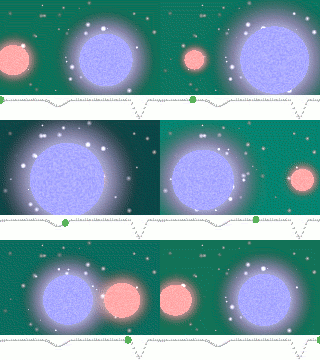
From Wikipedia - the suggested rotation of Algol
However, after the sequel came back from my editor, she questioned the term 'trinary', listing 'urnary', 'binary', and 'ternary'. So I went back to my research, specifically looking at terminology for multiple sun systems.

Although Algol is one of the best known eclipsing binaries, it's "actually a three-star system (Beta Persei A, B, and C) in which the large and bright primary Beta Persei A is regularly eclipsed by the dimmer Beta Persei B." (taken from Wikipedia). Multiple star systems consist of three or more stars that are physically close to one another and gravitationally bound. Most are triple stars, also known as ternary or trinary. Usually two stars form a binary system with a third orbiting the pair at a distance (hierarchical). Now, the last thing I want to do is bog down a reader with all the complexity of Algol's three stars. The essential element for me is that there are three suns, making the planet featured in the story a searing ball of sand valued only for its high mineral and metal deposits. As far as I can tell, the terms 'triple', 'trinary', and 'ternary' are all valid and interchangeable. I'd never heard of 'ternary' before, while 'trinary' sounds closer to the more commonly known 'binary', and so hopefully more understandable to a reader. But for now, I'm tempted to go with my editor's recommendation even though to me trinary is probably the more recognizable term. Which term do you find the most familiar? Which would make you go 'huh?'

Pippa's Journal

So, just over a week ago I got my first royalties statement. Squeee! Okay, so I'm not a bestseller or anything, but it really hit home the fact that I'm an author with a book that has sold actual copies. Seeing it in black and white makes it far more real. People have actually bought my book, and judging by the reviews they're enjoying it too. :)


On the writing side - I finally sent out my revised YA scifi novella Gethyon. I'm currently a third of the way through edits on Keir's sequel (which sadly needs a new name now) and polishing up the first 5K of my sfr novella Tethered for entry into the Rebecca, which closes on the 30th June - so if you're planning to enter, hurry up! There's apparently a shortage of entries. Also entry for the EPIC's eBook Awards™ opened from 1st June and goes through until the 15th of July. Please check with their website for details on eligibility and rules. 

Discoveries
Tracking your sales - thanks to Melisse Aires I already knew about NovelRank which tracks sales for your book on ALL Amazon sites as soon as a single copy sells. Mine is a little behind since it didn't start tracking until three days after Keir's release, but still a handy gadget. If you're an author with books on Amazon, you really need to sign up and fill out your profile on Author Central. Please note, you will need to do this on ALL the sites that sell your book. Unfortunately you can't just fill in one profile and have it feed to US, UK, German, French etc sites. But I found this site which has further tools for tracking your sales, including those through outlets like Barnes & Noble. 
  
Happenings

It's the SFR Brigade's Midsummer Blog Hop!!


On Friday 22nd June (Pacific Time) the SFR Brigade will be holding its first ever Blog Hop to celebrate Midsummer. 36 fabulous science fiction romance authors will be telling you mystical or scientific stories related to the event, and they'll each be giving away a prize - books, gift cards, swag bags...and lots more!

Plus there's TWO GRAND PRIZES!

1st Prize - a Kindle Touch or Nook Touch
2nd Prize -a library of science fiction romance titles from over 20 authors (these will be mostly ebooks with one print anthology), and an Anabanana Gift Card.

All you need to do to enter is pop along to the blogs listed below and comment on as many as you want (only ONE comment per site will count as an entry). Each time you comment at a stop, you'll earn one entry into the grand prize - so the more sites you visit, the greater your chances of winning. The winners will be drawn at random on the 24th June and announced on this site. The list of participating authors can be found below this post. Spread the news!

Ping Pong
At Donna - hugs on playing the waiting game. 
At Laurie - sorry about the Triple - maybe next year? I was interested to hear your view on Prometheus - I can't bring myself to watch any of the Alien films, but my husband went and was quite scathing in his view. I did try to get him to write a review of it to post to my blog, but he turned me down. O.o